


 Shrimp
 Fish
Fish Crab &
 Plants
 Foods
Foods Snails
Blue Leg Poso Shrimp Care | An Easy Sulawesi Shrimp?
Want to dive into the world of Sulawesi shrimp? The Indonesian Sulawesi lakes contain a wealth of fascinating and amazingly colored freshwater shrimp species. None are known to be easy to keep, but one is a little less shy and finicky than the others. Meet the charming blue leg Poso shrimp: challenging, but more than worth the extra work.
| Scientific name | Caridina caerulea |
| Common name | Blue leg Poso shrimp |
| Difficulty level | Hard |
| Origin | Lake Poso in Sulawesi, Indonesia |
Table of Contents
Blue leg Poso origins & natural habitat
Blue leg Poso shrimp are only found in a single locality in the wild: Lake Poso in Sulawesi, the Indonesian island formerly known as Celebes. This clear-watered, rocky lake forms part of Sulawesi's ancient lake system, which houses a unique variety of shrimp (as well as snails, fish, and crabs) that don't occur anywhere else in the world. This incredible range of endemic critters is the result of adaptive radiation. During this natural process, one or a few ancestors evolve, over time and in an isolated environment into an incredible range of species.
In their natural habitat, blue leg Poso shrimp spend much of their days foraging on vertical rocks. When they were initially described in 2009—Sulawesi shrimp haven't been around in the hobby for very long—they were thought to inhabit Lake Poso's shallows only. A 2025 study, however, found juvenile blue leg Poso shrimp at a whopping 240 ft of depth! We're excited to see what other new Sulawesi shrimp insights will be uncovered in the future.
Please note: Whenever we discuss Sulawesi shrimp, want to make sure we mention that these unique and fascinating invertebrates, including the blue leg Poso, are in serious trouble. Poso and the other lakes are under extreme ecological pressure from factors like invasive species and pollution; the IUCN Red List considers Caridina caerulea to be Vulnerable. Buying tank-bred shrimp is the way to go here.
Blue leg Poso shrimp description
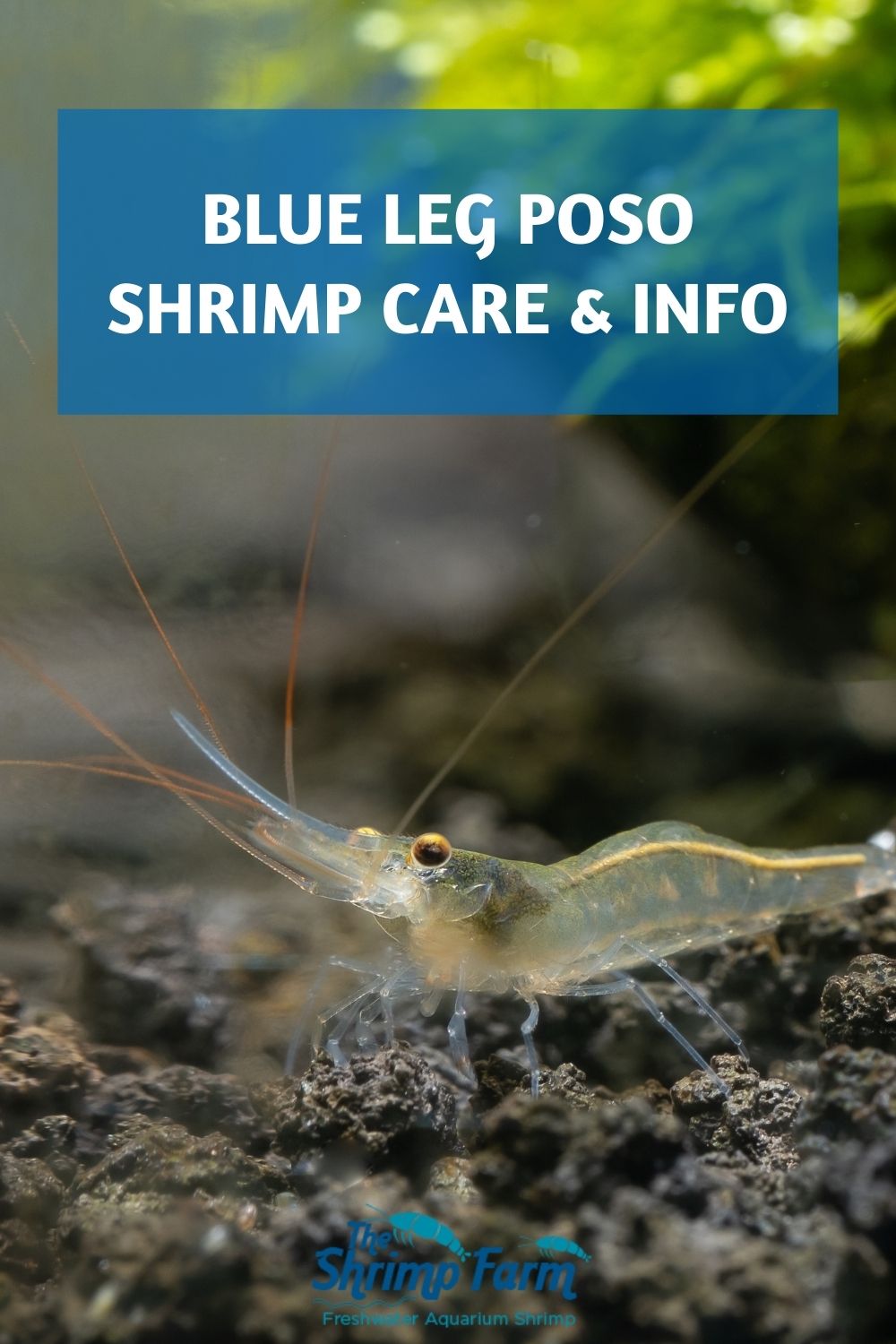
We often see the blue leg Poso shrimp described as "the boring but easy one". We'll admit these little (1") crustaceans don't instantly catch the eye the same way cardinal shrimp and most of the other types of Sulawesi shrimp do, but we do think they deserve a closer look. Between their spectacularly long blue rostrum (the nose, basically), blue legs (unsurprisingly), blue tail fan and orange antennae, they're actually pretty colorful. Their bodies aren't always transparent either, but can also be a sandy peach or even have a blue hue.
It's important to note the blue leg Poso's doppelgänger in Lake Poso: Caridina ensifera. The species are very similar in looks and live alongside each other. As such, when Sulawesi shrimp first entered the hobby, they were thought to be blue and red morphs of the same shrimp. C. ensifera is still often referred to as the "red morph shrimp". You can tell it apart from the blue leg Poso by looking at the two spots on the tail fan (the uropod). These will be bright blue in the blue leg Poso shrimp and dark brown to black in the red morph shrimp.
If you did mix up the red morphs and the blue legs and brought the "wrong" shrimp home, fear not. Shrimpers have found their care requirements to be almost identical, so you can still use the guidelines from this care guide.
Did you know? A blue leg Poso morph with increased blue to blue-green coloration on the body now pops up for sale from time to time. It occasionally occurs in the wild, too, but would need to be selectively bred to stabilize the spectacular color. We've seen it called "Ice Blue", but since sellers can slap any name on these color morphs, there's no telling what they'll be labeled as at your LFS!
Blue leg Poso shrimp requirements
Before we start: although blue leg Poso shrimp are often sold as "easy" Sulawesi shrimp, it's important to keep in mind that they're only easy compared to other Sulawesi shrimp. Most shrimpers still find them more difficult to keep and breed than Neos and even the more finicky bee shrimp. Caridina caerulea does make an excellent first Sulawesi species, but it's best to practice with cherries, bees or tiger shrimp before you attempt them.
The most important and challenging aspect of Sulawesi shrimp care is water quality. Not only should the parameters be just right, but they should stay just right at all times. These shrimp do not respond well to fluctuating water values, nor ammonia, nitrite, copper, nitrates and phosphates. Never introduce any livestock in an aquarium that hasn't been fully cycled; in fact, don't introduce Sulawesi shrimp like blue leg Posos into tanks under three months of age at all. Ammonia exists in its highly toxic form in Sulawesi tanks due to their high pH, so a rock-solid nitrogen cycle is absolutely essential.
Although blue leg Poso shrimp are very small, the volume of their home should be at least 10–15 gallons to help ensure stability. Most Sulawesi keepers use two sponge filters (or one sponge and one small internal/HOB filter), pointing the outlet of at least one at the water surface to improve oxygen exchange while keeping the flow gentle. It's important to choose a high-quality heater: although Poso isn't quite as toasty as Sulawesi's other lakes, its temperatures are still well within the tropical range.
Plenty of hides help the blue legs feel safe, while a dark-colored substrate of coarse sand or fine gravel—preferably inert, so without nutrients—helps their pretty colors pop.
→ Sulawesi shrimp care is too nuanced and finicky to describe in detail here. Before you buy blue leg Poso shrimp, please refer to the full Guide to Sulawesi Shrimp.
Water quality
If you want to keep blue leg Poso shrimp, imitating the water parameters of Lake Poso is essential. These shrimp are highly specialized and not at all adaptable like our beloved Neos, after all. The parameters they've adapted to are different from what most of us are used to: Lake Poso is rich in minerals but poor in nutrients, and its pH is high (alkaline).
The above means that if you let the nitrate and phosphate levels in your Sulawesi tank slip even a little, your shrimp can start to suffer. You can't do large water changes to make up for this, however, as the resulting subtle fluctuations can also be harmful. Instead, keep waste output to a minimum by removing uneaten foods instantly, and change out around 20% of the water a week. In order to prevent fluctuations that might upset the shrimp, you can use a drip kit to add the new water back in.
Although blue legs are a little more forgiving than most of their cousins (they may be able to thrive in high-quality tap water), RO/DI with a Sulawesi shrimp remineralizer is still the safest choice. And remember: daily water tests might be tedious, but not as dismal as losing all your shrimp.
Tip: Never top off evaporation with remineralized water. Use reverse osmosis water only in order to prevent the mineral levels from slowly creeping upwards, an issue thought to be a common cause of "random" Sulawesi shrimp colony collapse.
Temperature: 77–82°F
pH: 7.5-8.5
GH: 4-6°*
KH: 3-5°
Nitrate: <1 ppm
Phosphate: <0.01 ppm(!!!)
Conductivity: 93–107 µS/cm
*Parameters based on surface sampling of Lake Poso, but GH (general hardness) is not listed in most studies. This is what we can infer based on the other lakes.
Tankmates
If you've been grumpily thinking "I thought this was the easy Sulawesi shrimp", rest assured. Although you still need to be strict about water quality, you get a little more wiggle room when it comes to tankmates! Blue leg Poso shrimp are more prolific and bolder than most other Sulawesi species, meaning they aren't quite as easily outcompeted for food. Shrimpers have found they can do well in a mixed Sulawesi tank.
We haven't tried all of these combinations yet, but blue leg Posos should do well with:
- Sulawesi snails: the classic choice. Stick to one or two snails to prevent their waste from fouling the water. Try yellow or chocolate rabbit snails, for example.
- Sulawesi shrimp: Caridina caerulea is naturally found alongside Caridina ensifera, which also makes a good companion choice in the aquarium.
Some sources suggest Neocaridina or bee shrimp as Sulawesi tankmates, but we think these would suffer from the high temperatures required to mimic the lakes.
Blue leg Poso shrimp diet
Anyone who's read our other Sulawesi shrimp guides will be tired of us repeating the word "gunk" by now. We're sorry: gunk is king. In nutrient-poor Lake Poso, there's little to eat except biofilm, the thin slimy layer of bacteria, algae and other microorganisms that eventually forms on all underwater surfaces. Although adult blue leg Poso shrimp do pick at formulated foods, they just don't get all that excited about it. Additionally, feeding pellets or tablets regularly can mess up the water quality.
The solution? Offer a small amount of formulated shrimp food every other day, removing the leftovers after an hour or two. Powdered foods like Shirakura work best, although it's a good idea to offer them in a feeding dish to prevent your shrimp from making a mess.
The rest of your feeding efforts should be focused on growing biofilm. Luckily, this isn't difficult:
- Keep the tank's back and side panels uncleaned. It's visually horrific, but a shrimp buffet.
- Fill the tank with rockwork. That's where the biofilm grows in Lake Poso, so the shrimp are used to using it as their foraging grounds.
- Keep a few rocks in a bucket with a strong light pointed at it as a back-up.
→ We highly recommend you take a look at our chapter on Sulawesi shrimp diet to help ensure your blue leg Poso shrimp don't starve.
Breeding blue leg Poso shrimp
Sulawesi shrimp in general are known to be challenging to breed, their colonies usually slowly dwindling rather than growing in numbers. Not the blue legs. If you're providing solid Sulawesi shrimp care by keeping the water quality high and stable, as well as offering plenty of biofilm for the shrimp to feed on, you'll see berried females and babies aplenty.
Instead of simply disappearing after hatching, a good percentage of the baby Posos should make it to adulthood. They don't need any special care from you, just a healthy and gunk-filled environment to grow up in.
Buying blue leg Poso shrimp
Blue leg Posos have relatively good availability. They're not as attractive as the red Sulawesi species, but are a little easier to keep alive. Some specialized aquarium stores might carry them shrimp or be able to order them in for you, though you'll usually have to search online.
Sources & further reading
Dwiyanto, D., Bandjolu, K. P., Wowor, D., Annawaty, A., von Rintelen, T., Farajallah, A., & Perwitasari, D. (2025). First report on deep-water Caridina spp from Lake Poso, Sulawesi. In BIO Web of Conferences (Vol. 185, p. 02002). EDP Sciences.
Kaban, S., Ditya, Y. C., Makmur, S., Fatah, K., Wulandari, T. N. M., Dwirastina, M., ... & Samuel, S. (2023). Water quality and trophic status to estimate fish production potential for sustainable fisheries in Lake Poso, Central Sulawesi. Polish Journal of Environmental Studies, 32(5), 4083-4093.
Von Rintelen, K., & Cai, Y. (2009). Radiation of endemic species flocks in ancient lakes: systematic revision of the freshwater shrimp Caridina H. Milne Edwards, 1837 (Crustacea: Decapoda: Atyidae) from the ancient lakes of Sulawesi, Indonesia, with the description of eight new species. The Raffles Bulletin of Zoology, 57(2), 343-452.