

 Shrimp
 Fish
Fish Crab &
 Plants
 Foods
Foods Snails
Thai Micro Crab Care | The Tiniest Crab You'll Ever Keep
Thai micro crabs were introduced into the aquarium hobby less than twenty years ago, but are already among the most popular invertebrates for small tanks. They're appreciated among shrimp keepers for their mellow nature and similar requirements to shrimp, which make them a great option if you're looking for tankmates for your colony.
A lot is still unknown about Thai micro crabs, including where exactly they can be found in the wild, whether they're threatened, what water parameters they like best, and even how to breed them! Despite all this, aquarists have managed to figure out how to get these crabs to thrive in our tanks — find out all their secrets below.
| Scientific name | Limnopilos naiyanetri |
| Common names | Thai micro crab, Thai micro spider crab, false spider crab, pill box crab |
| Difficulty level | Moderate |
| Origin | Thailand |
Table of Contents
Thai micro crab natural habitat & appearance
Description
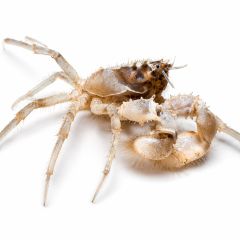
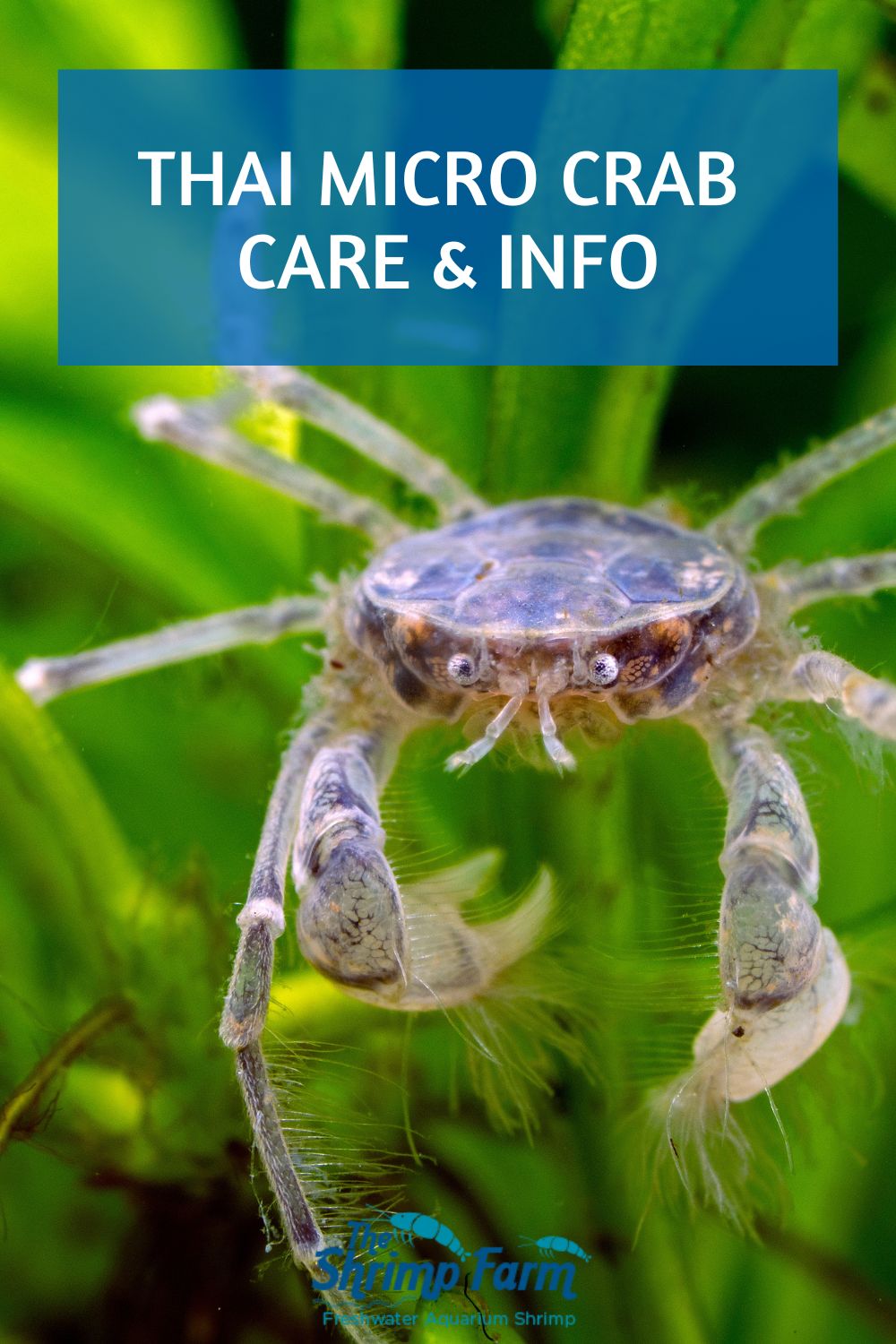
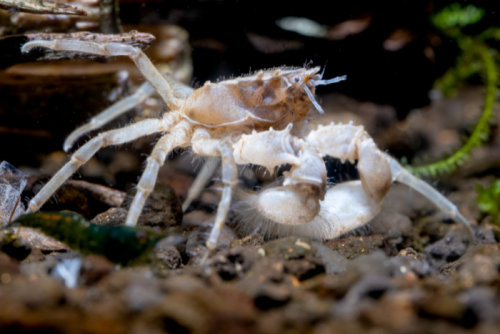
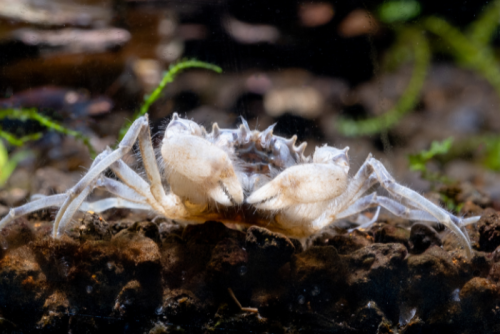
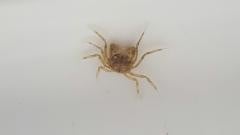
Thai micro crabs aren't called "micro" for nothing. These guys are TINY! Their carapace is usually less than 0.5" in diameter, and even with the legs included, they don't tend to surpass 1". Their bodies are greyish to beige in color, often with tiny speckles. They sport spidery legs and small claws that are unlikely to be of much use for crushing prey.
The Thai micro crab was the first member of the genus Limnopilos to be described scientifically. At first, some taxonomists considered this classification in an entirely new genus to be a mistake, instead placing this new species in the existing Hymenicoides. In 2007, though, the original description was validated when it was confirmed the two genera are notably different. Today there are four accepted species of Limnopilos, with the Thai micro crab being the most well-known.
Did you know? If you take a magnifying glass and look closely at a Thai micro crab, you'll notice they're quite hairy (researchers call this "pilose"). It's thought their "fur" allows them to catch particles that serve as food or camouflage — or both.
Natural habitat
As its name suggests, this crab is naturally found in Thailand. It's usually described as occurring in "a single river", though this doesn't seem to be entirely accurate. If researchers, Thai hobbyists and an iNaturalist sighting are to be believed, it's more like a single river system: they've been spotted in the Chao Phraya and at least one of its distributaries, the Tha Chin. The locals who collect them for the aquarium trade could probably tell us more, but no one seems to have actually filmed or photographed these crabs in their natural habitat — in the Chao Phraya or elsewhere — so far.
If you want to take a look at the Thai micro crab's stomping grounds, the best we can offer is a Google Street View link. The crabs inhabit the long roots of the floating water hyacinth plants (Pontederia crassipes) visible around the river margins. An interesting habitat choice if you consider that water hyacinths aren't even native to Thailand, but it probably works well for because the dense, fuzzy root systems offer excellent cover for tiny crustaceans and catch plenty of small edible particles.
It has to be noted that the Thai micro crab's natural habitat is severely threatened by pollution. Agricultural runoff, sewage, and industrial waste have turned the Tha Chin and surrounding river basins eutrophic in many places. This means ammonia and nutrient spikes, which stimulate harmful algal blooms that can deplete so much oxygen no fauna can survive. Aquarists have found Thai micro crabs to be pretty sensitive to bad water quality, so the species could be in severe trouble without anyone paying much attention.
Setting up a Thai micro spider crab aquarium
Requirements
As mentioned in the introduction, Thai micro spider crab care and requirements are pretty similar to those of dwarf shrimp. This means you definitely won't need a large aquarium, though due to the crabs' sensitive nature, you do have to keep an eye on the water parameters. A small colony (up to 10) can be sustained in an aquarium of at least 5 gallons and will do well with just a simple sponge filter. Keeping these crabs in a slightly larger tank (10+ gallons) might be easier, though: a larger volume of water is easier to keep stable.
Also like dwarf shrimp, Thai micro spider crabs are shy and very much aware that most other creatures want to eat them. This means they need plenty of hiding places to feel safe; they'll actually run for cover when exposed to too much light! Although these crabs don't seem to be strictly nocturnal, they're often noted to only come out after dark (which makes a night light for your aquarium an excellent idea).
The water hyacinth these crabs inhabit in Thailand is illegal to grow in many US states. It's highly invasive and can quickly ruin local waterways if it gets out. Luckily, there are many other floating plants with long roots that your Thai micro crabs will love to hide and forage in.
Water quality
It's not actually 100% clear what Thai micro crabs need in terms of water parameters — there are no published readings for the river(s) they supposedly inhabit to be found anywhere. Still, we can assume the water to be lightly acidic to lightly alkaline, with moderate hardness. Stability is more important than chasing perfect numbers anyway!
As we've mentioned, Thai micro crabs can be fragile. This means the aquarium should be fully cycled and have had time to properly mature (3+ months) before you can safely add them. Slow drip acclimation will help prevent shock. After introducing the crabs, keep a close eye on the water quality at all times using a liquid test kit (and try not to slack off when it comes to maintenance). Small weekly water changes with temperature-matched water, preferably using a drip test kit, should help keep the water parameters stable.
pH: 6.5–7.5
Temperature: 71.5–82.5 °F
Hardness: 70–150 ppm
Tankmates
Thai micro spider crabs are tiny, docile, and defenseless (those little claws seem to be for eating only, not pinching or fighting). You should never combine yours with larger fish, as no matter the species, they're sure to have a taste for crab legs. To prevent stress or even "mystery disappearances", the crabs should instead be surrounded by similarly mellow tankmates or just kept on their own. Small, peaceful options like pygmy cory catfish, Otocinclus, and tiny rasboras like the Boraras can work well.
The ideal tankmate choice for Thai micro crabs would be other invertebrates. They should get along well with most snails and will also co-exist peacefully with dwarf shrimp like cherries or Crystal Reds. The shrimp are a little bolder than the crabs, but shouldn't outcompete them if there's enough food to go around. Also, don't forget that Thai micro crabs seem to appreciate the company of their own kind! They probably feel safest in groups of at least three per tank, preferably more.
Thai micro crab diet
As we've mentioned, Thai micro crabs have small hairs on their claws. In the wild, these are likely used to catch any small food particles the crabs can find while foraging among aquatic plant roots and other floating "rafts". They're omnivores, and aquarists have found they're definitely not picky when it comes to food: detritus, small bugs, and plant bits are all welcomed.
In the aquarium, your crabs will spend much of their time foraging for micro-organisms in plants and algae. Because our home tanks are usually too clean to sustain them, though, supplementing their diet with a high-quality crustacean formulation is an excellent idea. Shrimp foods contain all the nutrients your crabs need to grow and molt.
Breeding Thai micro spider crab
Well, we don't really know what to tell you! Neither does anyone else — breeding Thai micro crabs is one of those things neither aquarists nor professional aquaculturists have figured out so far. This isn't because they don't reproduce in our tanks, because they do. The problem is that when these crabs hit the market, it quickly became clear that their reproduction is similar to that of lower-order shrimp.
Basically, Thai micro crabs don't hatch as fully developed mini-copies of their parents. Instead, they start out as tiny larvae that must metamorphose multiple times before they can be considered "real" crabs. This tracks with the rest of the family Hymenosomatidae to Thai micro crabs belong, but makes rearing them much more difficult than with crustaceans that don't have to pass through a larval stage. Many people have gotten the larvae to hatch, but they always starve within a few days because no one can quite figure out what they eat.
At first, some aquarists thought that Thai micro crabs might be like Amano shrimp in that their larvae hatched in freshwater, but then needed brackish water to develop before moving back to fresh. Most now believe they're more like ghost shrimp — spending their entire life cycles in freshwater — but as far as we know, this hasn't actually been confirmed. We haven't seen any reports on larval rearing attempts in brackish water, though one Thai aquarist reports the adults at least don't care much about a little salt. That makes sense for a family of crabs whose members vary from marine to brackish to freshwater!
In any case, if you have a few Thai micro crabs and one of the females becomes berried, you can always try to give raising the larvae a try. If you crack it, eternal aquarium glory is all but guaranteed.
Frequently asked questions
A lot of this depends on your specific aquarium, but one crab per gallon actually isn't a bad rule of thumb.
Unfortunately, these crabs don't seem to be very long-lived. Their lifespan is usually around a year and a half.
Where to buy a Thai micro crab?
Although Thai micro crabs are no longer brand new in the hobby, not all aquarium stores seem to have caught on yet. If yours doesn't have any crabs in stock, you can try asking the staff to order a batch in for you. This does mean you might have to wait a few weeks.
We're excited to offer you our adorable Thai micro crabs here at The Shrimp Farm! You can get your crabs shipped right to your doorstep for a low flat shipping rate and with live arrival guarantee — no need to leave the house to stock your tank.
HYMENOSOMATID, T. N. S. O. PRELIMINARY DESCRIPTIONS OF ONE NEW GENUS AND THREE NEW SPECIES OF HYMENOSOMATID CRABS FROM SOUTHEAST ASIA (CRUSTACEA: DECAPODA: BRACHYURA).
Chuang, C. T., & Ng, P. K. (1994). The ecology and biology of Southeast Asian false spider crabs (Crustacea: Decapoda: Brachyura: Hymenosomatidae). Hydrobiologia, 285(1), 85-92.
Ng, P. K., & Chuang, C. T. (1996). The Hymenosomatidae (Crustacea: Decapoda: Brachyura) of southeast Asia, with notes on other species.
Ng, P. K. (2007). On the taxonomy of the genus Hymenicoides Kemp, 1917 (Crustacea: Decapoda: Brachyura: Hymenosomatidae), with resurrection of Limnopilos Chuang & Ng, 1991, and descriptions of two new species.
Patoka, J., Bohatá, L., Karella, T., Marková, J., Yuliana, E., & Yonvitner. (2019). Invasive potential of pet-traded pill-box crabs from genus Limnopilos. Diversity, 11(6), 91.
Simachaya, W., & Heathcote, I. (1999). Integrated water quality management in the Tha Chin River Basin, Thailand, using the linkage of a simulation model and a desktop GIS. In WRPMD'99: Preparing for the 21st Century (pp. 1-8).