


 Shrimp
 Fish
Fish Crab &
 Plants
 Foods
Foods Snails
White Cloud Mountain Minnow | Caring for the "Poor Man's Neon Tetra"
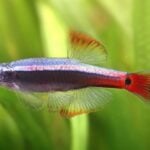
Say hello to a fish that's been in the aquarium hobby for over 90 years! After its discovery in 1932 in China, the white cloud mountain minnow quickly conquered the world. It was once known as the poor man's neon tetra, but we know better by now — this is an aquarium superstar in its own right, especially for unheated tanks and first-time aquarists.
Let's find out what makes white clouds so great, plus what they'll need to thrive in your aquarium.
| Scientific name | Tanichthys albonubes |
| Common names | White cloud mountain minnow, Chinese danio, cardinal fish |
| Difficulty level | Easy |
| Origin | Southern China |
Table of Contents
What’s a white cloud mountain minnow?
Description
How pretty is the white cloud mountain minnow?! Not a minnow at all, its genus is actually the sole member of its own family, the Tanichthyidae. Rarely reaching more than 1.5" in length, these little fish can be recognized by their torpedo-shaped bodies, oversized, fan-like anal and dorsal fins, and of course their stunning colors.
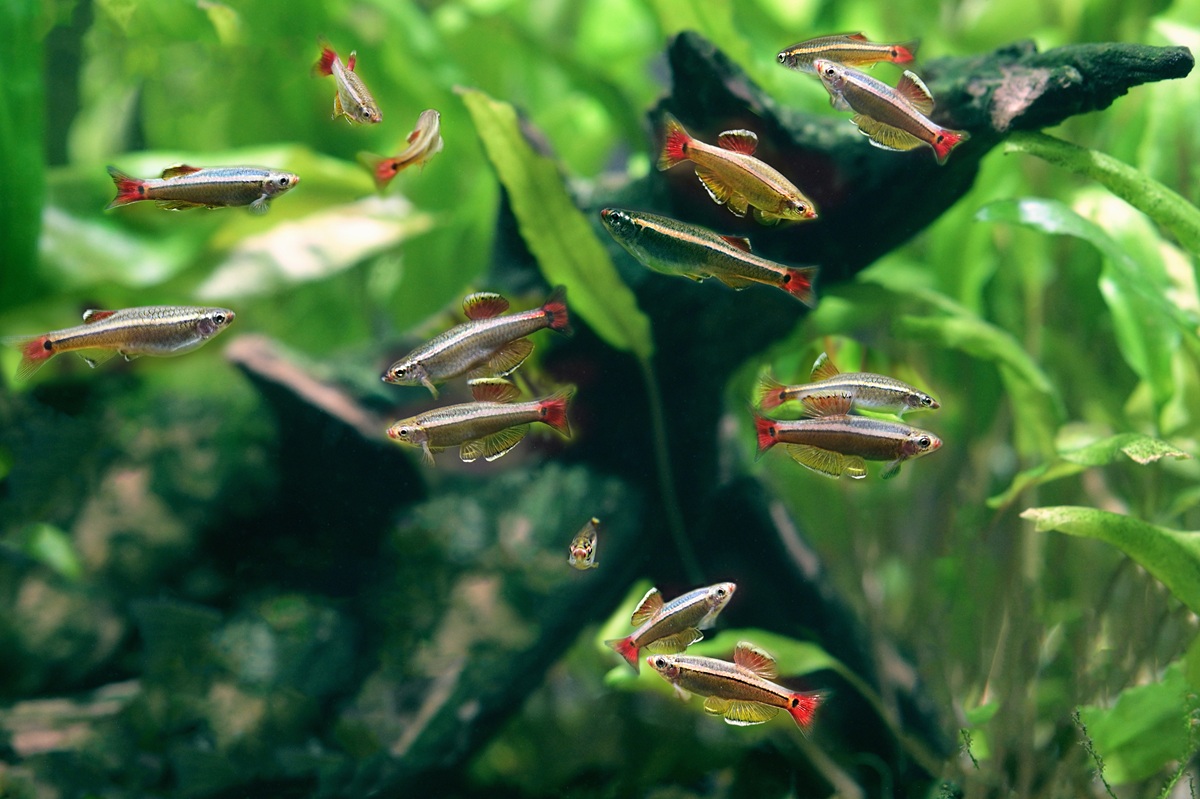
Male white clouds in particular are real lookers, especially during breeding time when they're busy trying to woo the females. Wild-type fish have shimmering, greenish backs, a thin dark lateral line with a fainter light pink line above it, and red and white fin accents. The mouth can also be bright red. This being said, nowadays you can find all sorts of selectively bred white cloud color morphs at your LFS: gold, meteor (long-finned), blond (yellowish, lacking most of their pigment), and even pink.
Natural habitat
White cloud mountain minnows were named after their type locality: Baiyunshan (White Cloud) Mountain, today a hiking area smack-dab in the middle of the huge Guangzhou metropolis in Guangdong Province. They're very rare in nature and were in fact long thought to be extinct. Luckily, a few other populations are now known from the Pearl River delta. The fish were also discovered on nearby Hainan Island.
True to their name, white clouds aren't found in the lowlands. They only occur in small mountain streams. These brooks are usually spring-fed and characterized by slow to medium flow levels, clear water, river rocks, and dense aquatic and riparian vegetation around the edges. White cloud habitat is unfortunately under severe pressure from human activity, especially deforestation and pollution.
Did you know? Tanichthys albonubes was thought to be the only member of its genus for a long, long time. It was finally joined by the Vietnamese cardinal fish in 2001. The genus has ballooned in the 2020s, though: researchers have discovered that some populations of "white clouds" are so genetically distant from T. albonubes that they constitute separate species. There are now nine Tanichthys, though only the first two can be found in the aquarium hobby.
Your white cloud mountain minnow aquarium
Requirements
Despite their small size, white cloud mountain minnows don't make a good choice for ultra-nano tanks. You can probably get away with a very long 10-gallon setup, as they don't care much about depth, but going 15+ gallons usually works best. All you have to do is add some rocks and plants, and your white clouds will be happy! Because these aren't tropical fish, a small pond can also work well in temperate regions.
If you'd like to set up a white cloud mountain minnow biotope tank, your best bet is a sandy substrate, plenty of river rocks, and some plants (Vallisneria, Taxiphyllum) around the margins. There should be some flow, but don't overdo it. White clouds occur in the calmer parts of the mountain streams they inhabit, not in the rapids. If you need inspiration, you can find a video of white clouds in the wild on Chinese platform Bilibili!
Water parameters
We can't find much in the way of published surveys of the water parameters that white cloud mountain minnows would encounter in the wild. There is one lead, though: a 2009 paper calls the water in the Hainan site "soft and acidic" and lists a pH of 6.4. This doesn't really track with the pH range up to 8.5 that's sometimes listed for white clouds, but then again, this was only one measurement during the dry season.
Anyway, white cloud mountain minnows are flexible. As long as the tank is fully cycled and receives regular water changes, they'll do well in a wide range of water parameters. Just don't let things get too toasty; the Chinese survey mentions 79.5°F in summer, so brief spikes likely aren't a problem, but they shouldn't be kept at this temperature year-round. Room temp should be ideal, though we've read reports of people overwintering these guys in iced-over ponds.
pH: 6.0–7.5
Temperature: 55–72°F
TDS: 90–350
Tankmates
One of the main reasons white cloud mountain minnows have been ubiquitous in the aquarium hobby for so long is that they get along with anyone who's nice to them. Given their flexible nature, all peaceful community species that don't mind their water a little cooler are fair game. You should also be sure to surround them with plenty of their own kind: white clouds kept in groups of 10+ are more outgoing, active, and vibrant.
Consider:
- Danios, like the celestial pearl danio
- Giant danios (Devario sp.)
- Medaka ricefish
- Cool-water cory catfish, like panda cories
- Cool-water barbs, like rosy barbs (Pethia conchonius)
- Some rasboras, like the phoenix rasbora (Boraras merah)
- Some tetras, like the ember tetra (Hyphessobrycon amandae)
You should look up the temperature requirements for the fish you're interested in keeping before adding it to your white cloud tank. Shrimp also work, though we would recommend Neos rather than slower-breeding bee shrimp. White clouds will leave the adults alone, but may snack on newborn baby shrimp; densely plant the tank to help keep losses to a minimum.
Decided to go for the mountain stream biotope we mentioned earlier? We could do with a few more surveys of Southern Chinese mountain habitats and their inhabitantd, but a few species have been confirmed to occur alongside white cloud mountain minnows in the wild:
- Paradisefish (Macropodus opercularis), only with adult white clouds!
- Golden barb (Barbodes semifasciolatus)
- Chinese minnow (Aphyocypris normalis)
- Laos medaka (Oryzias pectoralis)
- Weather loach (Misgurnus anguillicaudatus)
- Freshwater gobies (Rhinogobius sp., multiple species)
Tip: We have to mention that "peaceful community species" doesn't include goldfish, which are still sometimes listed as suitable white cloud tankmates. Sure, their temperature requirements overlap — but aside from the fact that they need huge tanks, adult goldfish will eat small fish if they manage to catch them.
White cloud mountain minnow diet
Like most small schooling fish, white cloud mountain minnows are opportunistic omnivores. That's a polite way of saying they'll eat anything that might be nutritious and can fit into their mouths! Your white clouds will happily accept any kind of high-quality formulated microfood. You can split their daily allotment into 2–3 small portions.
One thing to keep in mind is that variety is the spice of life for fish, too. Granules and flakes may have all the nutrients your fish need, but it's still an excellent idea to regularly include portions of (thawed) frozen foods like bloodworms and mosquito larvae. In fact, if you really want to spoil them, go for live. We like baby brine shrimp as a one-off or Daphnia if you're interested in setting up your own culture.
Breeding white cloud mountain minnows
White cloud mountain minnows make an excellent breeding project, even if you've never tried your hand at breeding aquarium fish before. They're typical egg scatterers that spawn throughout the year. A healthy population in a densely planted tank will usually expand over time without any intervention on your part. If you want to maximize the survival rate, though, it's best to set up a simple rearing tank that separates the babies from their family until they're large enough to avoid being eaten. Filial cannibalism (the act of an animal eating its own offspring) is unfortunately pretty rampant in aquarium fish.
Setting up a spawning/rearing tank for your white cloud mountain minnows is easy. All you need is an old aquarium or food-safe tub of around 10 gallons and a nice, big bunch of Java moss. Add a sponge filter (seeded with material from the display tank to insta-cycle it) and ensure the water parameters fall within the ideal range for white clouds — and you're all done.
Now you just need to feed the prospective parents plenty of nutritious (live) food and wait for the females to become gravid. Source some infusoria, as well as microworms or brine shrimp eggs, in the meantime; freshly hatched baby white clouds are much too small to eat the same foods their parents do.
Once your female white clouds look nice and round, you can introduce one or multiple pairs into the spawning/rearing tank. Eggs should appear soon. Be sure to remove the parents after a day or two so all the hard work isn't for nothing! Depending on temperature, the first baby white clouds appear after as little as two days. They live off their yolk sacs at first and can be started on infusoria once they start swimming freely. Once they're big enough, you can switch to baby brine shrimp or microworms.
Buying white cloud mountain minnows
Inbreeding depression is a problem in white cloud mountain minnows — not surprising given how few wild populations are out there. This means it's worth taking a moment to try and make sure you're buying high-quality fish.
If you decide to shop in person, be sure to pick white clouds that are free of spinal deformities (S-shape, odd humps) or buoyancy issues (indicative of swim bladder problems). They should be active and eat readily. If they look bad, it really is worth waiting until the next batch comes into the store. Bright and colorful specimens are your best bet, although it has to be said that even healthy fish can look drab in overcrowded, stressful store tanks!
If you're buying online, be sure to shop at a reputable dealer who is known for picking their stock carefully and won't sell unhealthy-looking fish. We're delighted to offer you our healthy, carefully selected and vibrant white cloud mountain minnows here at The Shrimp Farm. That includes the gorgeous golden color morph — always with live arrival guarantee.
Sources & further reading
Chan, B. P. L., & Chen, X. L. (2009). Discovery of Tanichthys albonubes Lin 1932 (Cyprinidae) on Hainan Island, and notes on its ecology.
Jin, J., Li, C., & Zhao, J. (2022). Descriptions of six new species in White Cloud Mountain minnow Tanichthys albonubes complex (Cypriniformes: Tanichthyidae) in southern China. Journal of Fish Biology, 100(4), 1062-1087.
Luo, J. Z., Lin, H. D., Yang, F., Yi, Z. S., Chan, B. P., & Zhao, J. (2015). Population genetic structure in wild and hatchery populations of white cloud mountain minnow (Tanichthys albonubes): Recommendations for conservation. Biochemical Systematics and Ecology, 62, 142-150.