


 Shrimp
 Fish
Fish Crab &
 Plants
 Foods
Foods Snails
Sparkling Gourami Care | The Pocket Rocket for Your Aquarium
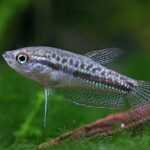
Looking for a fun and interactive fish to keep in your aquarium, but don't have a lot of space to offer? Maybe something similar to the ultra-popular Betta fish, but suitable for community tanks? We've got the solution: it's called the sparkling gourami. Colorful, full of personality and not against sharing its space with peaceful tankmates, this little labyrinth fish may just be the perfect choice for a planted desktop aquarium. Find out more below!
| Scientific name | Trichopsis pumila |
| Common names | Sparkling gourami, pygmy gourami |
| Difficulty level | Easy to moderate |
| Origin | Southeast Asia |
Table of Contents
What’s a sparkling gourami?
Description
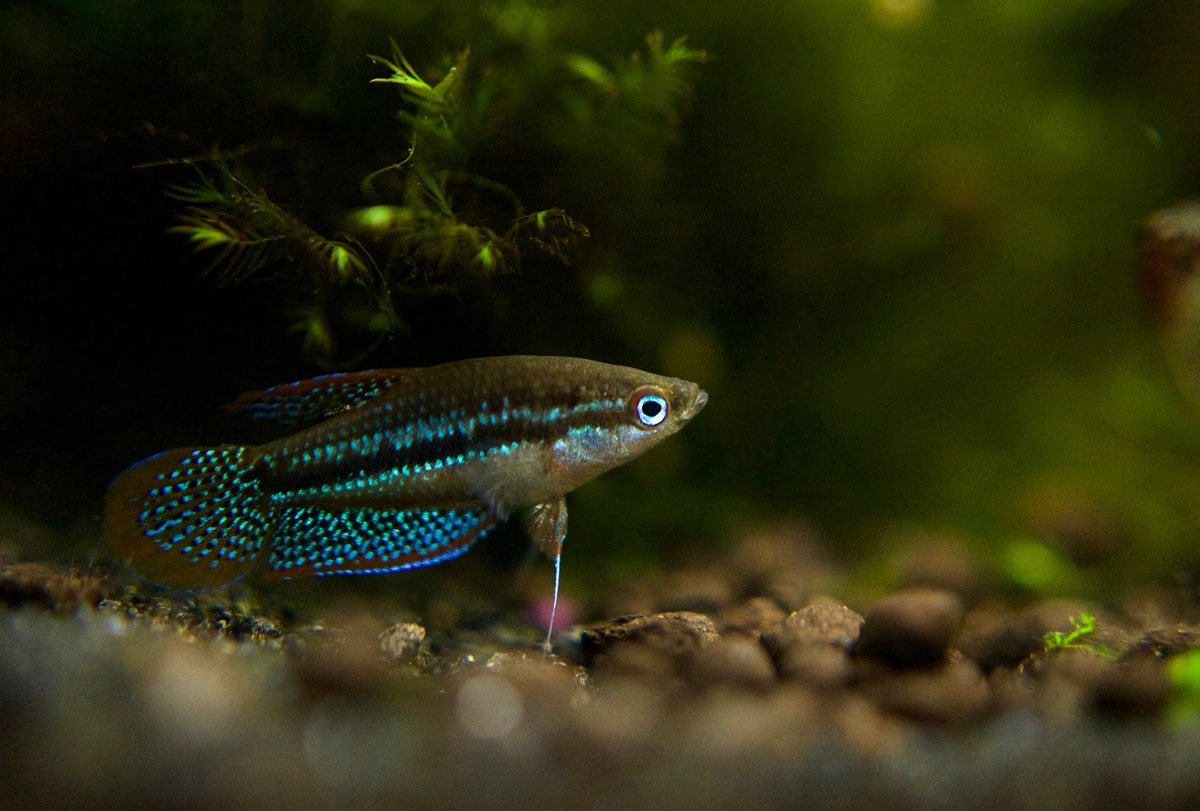
"Sparkling" is a pretty accurate name for a gourami whose glittering green-blue scales and reddish dots give Rainbowfish from the children's books a run for his money. The males in particular are just stunning! Then again, so is "pygmy": this tiny number rarely reaches more than 1.5" in length. It sports all the typical gourami characteristics, including the sensitive feelers (highly modified pelvic fins), upturned mouth and hovering swimming style, but in perfect miniature.
You can tell the sparkling gourami apart from the closely related and visually similar croaking gourami (Trichopsis vittata) by its shorter fins and brighter colors, but not by a lack of croaks — even though only one of them was named for it, all three members of the genus Trichopsis emit audible grunts, clicks and purrs when they're feeling territorial or frisky. They don't have vocal cords, but instead produce their noises by plucking two modified pectoral fin tendons.
Like the ultra-popular Betta fish, sparkling gouramis belong to the suborder Anabantoidei (the labyrinth fish) in the family Osphronemidae (the gouramis). This means they possess a special "labyrinth organ" that allows them to breathe air. They can even survive out of water for a short period of time — though we recommend keeping yours submerged for the best results. 😉
Natural habitat
Like most labyrinth fish, the sparkling gourami naturally occurs in slow-moving to still waters in Southeast Asia, particularly in the Mekong River Basin. It can be found in swamps, sluggish rivers and seasonal wetlands, but also pops up in man-made environments like rice paddies and canals.
Some of these habitats, like peat swamps, are heavily tannin-stained ("blackwater"), while others feature clear water. What they all have in common is abundant vegetation, either aquatic or along the margins. This helps shade the water from the harsh tropical sun and provides the cover these tiny fish need to avoid predators and find their favorite meals.
Your sparkling gourami aquarium
Requirements
Microfish like the sparkling gourami don't need a lot of space to thrive. They work well for desktop aquarium of 10 gallons and up, although of course, they'll also do well in larger systems. Just be sure to go for a rectangular tank, not a square or tall one! Labyrinth fish need to be able to easily and quickly reach the surface to breathe. They naturally occur in shallow waters, sometimes barely 3–4" deep and rarely more than 15", meaning they do best in long, low tanks.
We asked Alex Bell, editor of Practical Fishkeeping Magazine and Great Britain's resident blackwater guru, what a sparkling gourami tank should look like. The (highly convenient) answer is that you can go almost any direction you want: "Sparkling gourami are a fascinating species, occurring naturally in both flooded fields filled with greenery and tannin-stained swamps carpeted with fallen leaves. Whatever your aquascaping style, they fit in perfectly."
As long as you keep their need for plenty of cover in mind, you've got loads of options for your gourami aquarium. Bell himself is a big fan of botanicals and often goes for blackwater tanks with ample driftwood, leaf litter and seed pods, sometimes continuing the scape above the surface with tropical plants. This is not a must, though: you can also go fully green with clear water and abundant aquatic plants. Just avoid harsh lighting or strong flow — you're aiming for peaceful shaded rice paddy, not raging river!
*Do use a lid, or alternatively keep the water line significantly below the rim of the tank. Labyrinth fish need a layer of warm, moist air above the water — cold can make them sick — and anyway, most aquarium fish are jumpers that seem to want nothing more than to go "carpet surfing". Nothing's worse than getting home after a long day and finding your favorite fish shriveled on the floor.
Water parameters
Although sparkling gouramis aren't particularly picky about water parameters, they do best in slightly soft and acidic water. Not surprising given they can pop up in peat swamps and other ultra-acidic habitats! As always, you should only introduce these gouramis into fully cycled aquariums. Small weekly water changes will help keep the water quality high.
pH: 6.0–7.5
Temperature: 71–83°F
TDS: 20–200 ppm
Tankmates
The best sparkling gourami tankmates are other sparkling gouramis: although the males will squabble and should be limited to one fish per tank in smaller set-ups, other combinations get along swimmingly. The little inter-gourami interactions between pairs, or harems consisting of one male and multiple females, are fascinating to watch.
We think sparkling gouramis make excellent candidates for a single-species aquarium — a pair or small group provides plenty of entertainment (Bell: "Due to their small size, many people assume nano fish lack character and personality, but for me, the sparkling gourami proves that assumption entirely false."). Community set-ups are also an option, but it's important to keep things very mellow to prevent the gouramis from being outcompeted or bullied. Very small schooling fish like tiny rasboras (Boraras, harlequin, kubotai) and tiny tetras (ember, green neon) are never a bad idea, nor are peaceful bottom dwellers like loaches (Pangio, Petruichthys, Hara jerdoni) and pygmy corydoras.
If you're setting up a Southeast Asian biotope tank and only want to include species your sparkling gourami may have come across in the wild, you're in luck. These waters teem with small fish also kept in home aquariums, some of which are perfectly compatible with pygmy gouramis. You can try:
- Exclamation point rasbora (Boraras urophthalmoides)
- Blackline rasbora (Rasbora borapetensis)
- Pearl danio (Danio albolineatus)
- Blue panchax (Aplocheilus panchax)
- Five-banded barb (Desmopuntius pentazona)
- Giant kuhli loach (Pangio myersi)
- Silver loach (Pangio anguillaris, rare)
What about shrimp? Well, let's put it this way: we wouldn't keep our prized bee shrimp in a sparkling gourami tank. As we'll see below, bugs are their favorite food. Prolific cherry shrimp may work in densely planted tanks, but you should be prepared to lose most of the fry. You've still got one excellent option, though: Amanos, which can grow as large as a sparkling gourami and therefore don't make for a convenient dinner.
Sparkling gourami diet
Their typical upturned mouths reveal what sparkling gouramis like to eat in the wild. Bugs, bugs, and more bugs! There are no specific studies on Trichopsis stomach content, but it's safe to assume that like other labyrinth fish, they feed on both fallen insects at the water surface and all kinds of aquatic larvae and microcrustaceans.
Your captive sparkling gouramis will accept any kind of floating microfood. Special Betta formulations should work well and are very easy to find. This being said, we encourage you to also regularly feed frozen options (bloodworms, mosquito larvae, and more — multipacks with mixed options exist) and even to try live food if it's feasible for you. Seeing your sparkling gouramis go nuts chasing down live Daphnia makes the extra hassle more than worth it.
Breeding sparkling gouramis
If you're used to breeding egg scatterers — i.e. most popular aquarium fish —, trying your hand at labyrinth fish is like entering a whole new universe. Instead of dumping their eggs in fine-leaved plants and leaving the fry to fend for themselves, the Anabantoidei make excellent parents. Or at least the dads do: they take care of everything from building the nest to getting the babies through their few days of life. Aside from providing a private (tankmate-free) breeding tank and nutritious food, you don't really have to do anything until the fry are 2+ days old.
Did you say "the nest"? Yes! One of the reasons so many aquarists love breeding Bettas and other labyrinth fish is that the process begins well before the actual laying of the eggs, and it's like having the Animal Planet channel play out in your own home. The male will start by locating a suitable spot at the surface, preferably near a leaf or some floating plants. Once he's found what he's looking for, he'll build a bubble nest consisting of loosely congregated air bubbles stuck together with saliva.
When the bubble nest is done, the female is finally allowed nearby. She'll produce purring sounds to initiate the spawning process, during which the fish repeatedly wrap around each other in a tight embrace. Small batches of eggs, up to 150 in total, are produced and dutifully inserted into the bubble nest by the male. Once the female is done producing eggs, she's shooed away while the male protects and tends to the eggs. No need to remove her, though — these gouramis are much less prone to eating their own eggs and babies than the majority of other aquarium fish.
The male keeps up his parental care after the eggs hatch (which takes only two days or so), at least until the fry have absorbed their yolk sacs and begin swimming freely. He'll keep intruders away and carefully place any fallen babies back into the nest. Once the baby gouramis are free-swimming, you can take over: offer infusoria initially and then switch to baby brine shrimp until they're big enough to accept regular fish foods.
Did you know? Male labyrinth fish will build bubble nests even if there are no females around. They like to keep up the practice sessions so they're ready when a lady does stop by!
Buying a sparkling gourami
Sparkling gouramis are popular aquarium fish; you should be able to find them at most specialized aquarium stores, or at least request to have them ordered in. Pick vibrant, active fish with round (but not overly fat) bellies, but don't get too hung up on color. As Alex Bell reminds us, "these little gems almost hide in plain sight. Their colours can appear plain – or even washed out – especially in shop tanks." Do be sure to verify you're buying the right species: the other Trichopsis look very similar, but grow a little larger than the pygmy sparkler.
Don't have an aquarium store near you or just don't feel like going out? Nowadays, you can also easily order aquarium fish online. The Shrimp Farm is proud to offer you our beautiful sparkling gouramis, with live arrival guarantee!
Sources & further reading
Liesch, N., & Ladich, F. (2020). Both sexes produce sounds in vocal fish species: testing the hypothesis in the pygmy gourami (labyrinth fishes). Journal of Experimental Biology, 223(10), jeb223750.
Tate, M., McGoran, R. E., White, C. R., & Portugal, S. J. (2017). Life in a bubble: the role of the labyrinth organ in determining territory, mating and aggressive behaviours in anabantoids. Journal of Fish Biology, 91(3), 723-749.