


 Shrimp
 Fish
Fish Crab &
 Plants
 Foods
Foods Snails
Otocinclus Care | Algae-Eating Champion & Best Shrimp Tankmate
Did you know that the most efficient algae-eating fish for your aquarium is also one of the smallest? And did you know it gets along swimmingly with shrimp? Otocinclus catfish are among the sweetest-tempered and most useful fish in the hobby, but their passive nature also makes them fragile. Below, we'll discuss why so many aquarists fail to keep their Otos alive (hint: it's definitely not always their own fault) and what you can do to make sure these adorable tiny catfish thrive in your tank.
| Scientific name | Otocinclus sp. |
| Common names | Oto, Otto |
| Difficulty level | Moderate to hard |
| Origin | Eastern South America |
Table of Contents
What’s an Otocinclus catfish?
Identity
As so often happens in the aquarium hobby, Otocinclus catfish identity is the source of some considerable confusion. Luckily it doesn't actually make a difference for their care requirements — so feel free to scroll past this section — but for the taxonomy nerds: there are currently almost 20 recognized species of Otocinclus, but not all taxonomists feel confident the genus has been fully resolved. More species may be hiding in the South American jungles and in trade shipments. The latest addition was described quite recently, in 2016, while our personal favorite stems from 2006 (dubbed O. batmani because the marking on its tail resembles Batman's personal symbol!).
A move to a genus called Macrotocinclus was proposed for some Otos in 2001, but the response was pretty lukewarm. A 2017 taxonomical paper listed all these catfish as Otocinclus again, treating Macrotocinclus as a synonym. You'll still see the latter used in some places, however.
The really confusing part, especially for hobbyists, is that most Otos look very similar. Although there are some exceptions, like the striking zebra Oto (O. cocama), most species in the hobby are brownish with a darker lateral stripe. The most frequently kept species according to Planet Catfish users is O. affinis, but this is actually unlikely to be true: this Oto's natural range, as far as is known, is very small and would make such massive exports impossible.
Most hobbyists and experts now think the O. affinis matter is probably the result of mislabeling by exporters and importers, arguing that the most common species in the trade are actually O. macrospilus and O. vittatus, among other possible candidates. We think this is likely... but we also think the confusion runs so deep that we're best off sticking to simply labeling our own Otos "Otocinclus sp.". It seems to be the only way to avoid misinforming buyers, especially because shipments from South America sometimes contain multiple species mixed together. Again, at least their care requirements are identical!
Did you know? In Brazilian scientific literature, Otocinclus catfish are known as cascudinhos, an adorable diminutive that translates to something like "little armored guys" or "little armored ones". This sets them apart from the bigger plecos, the cascudos.
Appearance
Otocinclus catfish belong to the family Loricariidae, one of the most popular families in the aquarium hobby and better known as the suckermouth armored catfish (distinguishing them from the "regular" armored catfish, the Callichthyidae). This means that like those other aquarium superstars, bristlenose plecos and the rest of the L-numbers, their body is covered in a built-in armor of protective bony plates. Their mouth looks similar to a suction cup and allows them to scrape algae and biofilm off any smooth surface.
Unlike their bristlenosed cousins, which can grow pretty hefty, Otos stay very small. The largest species we've found in the aquarium trade is O. flexilis, which can be recognized by its blotchy pattern and lack of a lateral stripe, at 2.7" or so. Many of the others never reach 1.5" — that's smaller than some neon tetras!
Mimicry
One fascinating thing about Otocinclus catfish is that several species are likely Batesian mimics of certain cory catfish — and given that most Otos look quite similar, there may be more mimics hiding in the genus. Otos have good reason to cosplay as cories: long-time aquarists will know that the catfish formerly known as Corydoras (now scattered across multiple genera, like Hoplisoma and Osteogaster) possess secret weapons. Their dorsal and pectoral fins have toxic spines that make them unattractive to predators and can give inattentive aquarists a real jolt.
Otocinclus don't have spines or toxin glands. But because in many areas Oto and cory habitats overlap — and so do their natural predators — the Otocinclus can benefit from association with cories. If a fish has learned to steer clear of Corydoras to avoid being stung or getting its prey lodged in its throat, it will probably also avoid any species that look similar. One Otocinclus looks so similar to the cory it mimics (Hoplisoma diphyes) it was dubbed O. mimulus, which means something like "little mimic".
Natural habitat
Given their tiny size, you won't find Otocinclus catfish in raging rivers. They're associated with calmer riverbanks and small streams that feature a moderate to slow flow level. According to a 1997 overview of the genus Otocinclus, they don't like rivers with muddy bottoms. What they do like is plenty of vegetation, which they use to rest on and stay near the water surface: "(...)
Otocinclus (...) are found along quiet stream margins, showing preference for broad-leaf macrophytes and terrestrial grass blades extending into the water."
Your Otocinclus catfish aquarium
Requirements
Although Otocinclus catfish are tiny and can technically live in aquariums of 10 gallons or up, we prefer 20+ gallons, especially if this is your first time keeping them. Not only are these catfish very sensitive to low water quality, but they also need as much space as possible to graze (see next paragraph). You can decorate the aquarium with live plants, aquarium-safe rocks, and the Oto's favorite decor: driftwood.
If your aquarium is brand-new, WAIT before buying. Most Otocinclus die from starvation, not disease; it actually reminds us of the trouble people tend to run into with Sulawesi shrimp. The problem is that both Otos and Sulawesis don't really seem to be able to survive on commercial foods alone. They need a constant supply of biofilm and algae (also known as aufwuchs) to graze on, and that's exactly what newly cycled tanks lack. If you don't feel a thin, slightly slippery and slimy layer on uncleaned aquarium glass and other objects, it's too clean for Otos.
There are four easy ways to grow biofilm for your Otocinclus without nuking the nitrogen cycle by adding lots of organic waste. Note that you'll also have to do this for the quarantine tank or tub — see the section on Buying Otocinclus for more on that.
- Wait. If your aquarium already has a few inhabitants, it'll eventually start generating tasty gunk by itself.
- Leaf litter. Dried leaves and seed pods slowly decompose and attract the microbial communities that Otocinclus like to feed on.
- Leave the lights on for 12+ hours a day. One of the best ways to grow algae and biofilm fast.
- Bottled products. If you dose a little GlasGarten ShrimpFit (a product specifically meant to grow biofilm) or even just some aquarium plant fertilizer daily, the tank will soon be Oto-ready.
You can leave the side and back panels of the tank uncleaned for a larger edible surface area. Yes, we know you are trying to get rid of algae. The Otos will indeed take care of them for you, but it's very important to get them off to a good start after buying them. And there's no better way to do that than to serve them heaps of their favorite food!
Water parameters
Otocinclus catfish are pretty flexible when it comes to water parameters like acidity, hardness, and temperature. What these fragile fish absolutely can't stand, however, is ammonia, nitrite, or excess (>20) nitrate. Make sure the nitrogen cycle is rock solid before bringing your Otos home and stay on top of regular maintenance like removing uneaten food, vacuuming the substrate, and weekly water changes.
pH: 5.5–7.5
Temperature: 70–79 °F
TDS: 50–250 ppm
Tankmates
First and foremost: Otocinclus catfish are social beings, so a group of at least four fish is a good idea. But don't get an entire Oto army, either, because there's usually just not enough biofilm to go around! As for tankmates, there are two main points to keep in mind. The first is that you, as with the number of Otos, should take it easy. Overstocked tanks are always at risk of water parameter swings, which can be fatal to these little catfish.
The second is that you'd do well to put together a mellow ensemble without any large or particularly voracious fish (including Plecos). True, Otos are excellent at camouflage and probably pretty good at avoiding being eaten. But their timid nature also means other fish easily outcompete them for food, and we've already seen that keeping them well-fed can be a problem at the best of times
We recommend your typical peaceful community choices:
- Small tetras like embers
- Corydoras catfish like the bronze cory
- Kuhli loaches
- Small cichlids like Apistogramma or Mikrogeophagus
- Inoffensive top dwellers like gourami or clown killifish
You've got plenty of options for a South American biotope set-up, including when it comes to plants!
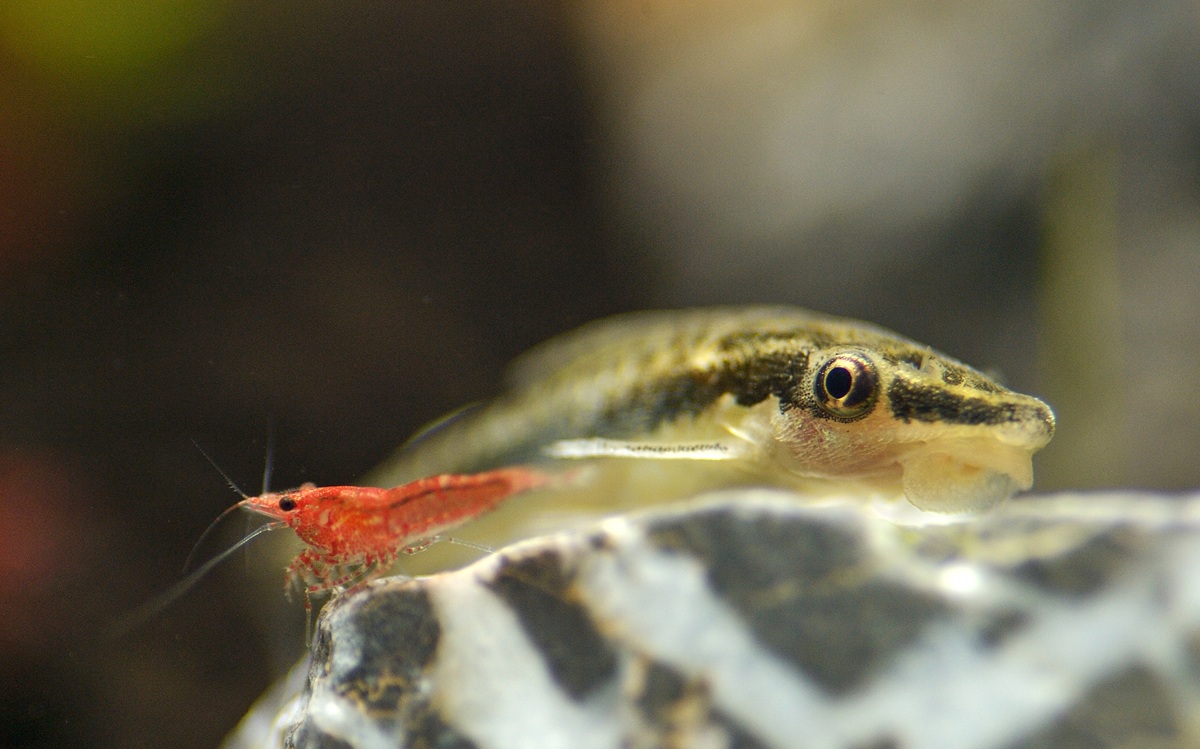
Lastly — and, in our opinion, most importantly — what about shrimp? We've already hinted at the fact that Otos are among the best tankmates your (dwarf) shrimp could wish for. You can find more info in the full post on Otocinclus & shrimp compatibility, but the basic gist is that these catfish are one of the few (or maybe the only) species in the aquarium trade that are unlikely to eat even newly hatched shrimp babies.
Otocinclus catfish diet
As we've seen, Otocinclus catfish mostly feed on biofilm and algae. They will help keep your tank clear of diatoms and soft green algae in particular. In very large (100+ gallons) and well-established aquariums, this means your Otocinclus are unlikely to need supplemental feeding. The biofilm and algae will never run out! In most "regular" systems, however, you should try to get any prepared foods you can into them.
Many aquarists swear by using homemade or prepared gel food, like Repashy Soilent Green (whose main ingredient is spirulina). It can be painted on rocks or driftwood when still liquid, left to set, and then introduced into the tank so it's almost like real biofilm.
The more foods your Otos accept, the better, so you can also try:
- Sticky or sinking algae tablets
- Blanched zucchini and spinach
- Nori (seaweed) sheets
- Frozen herbivore foods (reef section at your LFS)
- Regular frozen fare (sparingly, excessive protein can cause bloat)
Tip: We like to keep a good amount of Indian almond leaves and other leaf litter in our Otocinclus tanks. The leaves turn into little biofilm factories as they decay.
Breeding Otocinclus catfish
If you stuck around for the section on Otocinclus appearance, you'll know that some (and maybe most) species mimic cory catfish for safety reasons. Despite belonging to different families, their breeding behavior also happens to be very similar. If you've bred Cories before, the process will be familiar: feeding a higher-protein diet for conditioning, performing a large water change to simulate the rainy breeding season (optional), males chasing the gravid females, and even the typical T-position.
The difference between breeding Cories and breeding Otos is that the latter unfortunately produce such tiny babies that raising them becomes a real hassle. They also don't reproduce at all unless conditions are pristine, and it seems they want a very densely planted environment for their offspring. We say "seems" because honestly, knowledge is still lacking. We can't find any scientific papers on breeding Otocinclus, for example, just a single publication on their reproductive ecology.
You can set up a dedicated breeding tank if you're serious about breeding your Otocinclus, removing the parents once eggs appear. If the Otos spawn in your display tank, however, it's best to move the eggs to a separate container instead. Even shrimp like eggs for breakfast, plus a regular filter will instantly suck up the baby catfish once they hatch. A gentle sponge filter is your best bet.
If you've ever bred marine fish before, you'll know the drill when it comes to feeding teeny tiny babies. There should be plenty of biofilm available for the newly hatched Otos, and the ideal set-up would probably include green water or an infusoria culture. Powdered microfoods for baby fish can also work. Once the fry are a few days old, you can introduce foods like spirulina tablets or powder, as well as blanched veggies.
Buying Otocinclus catfish
This is a section to pay attention to when it comes to Otos! Aside from a lack of biofilm, which you now know how to grow, the main reason these little catfish have a reputation for being fragile is logistics. Because they can't be bred on a commercial scale yet, Otocinclus are usually wild-caught. That means they go through catching, holding, export and shipping, arrival at wholesalers, shipping again, arrival at your local LFS... they can take 1–2 months to reach your home aquarium.
Aside from the stress that being stuffed into a bare vat or bag with hundreds of other Otos entails, ornamental fish usually aren't fed much during the holding phase — and not at all during shipping (they'd produce too much waste and fail to survive the journey). Feeding at wholesalers and pet stores can be spotty as well. Most fish species are able to take the stress and lack of food pretty well, but Otocinclus don't. By the time you buy yours, they may already be too far gone.
So what should you do? There are a few tricks:
- Gunkify a quarantine tank (see 'Requirements') well in advance. Seed it with beneficial bacteria from the display tank, then just leave the lights on 24/7. The result after 2–4 weeks will NOT be pretty, but it will be what the Otos need. Make sure there is absolutely zero ammonia or nitrite present before you buy the fish.
- Ask the store when their Otocinclus shipments come in. Buy your fish the same day they arrive, so they don't spend even more time languishing in the store tanks*. If they have sunken bellies or look lethargic, wait for the next batch (this is more difficult when shopping online, but you can definitely ask the supplier when is the best time to buy).
- Acclimate the Otos very carefully using drip acclimation. Keep a close eye on them during the quarantine period, as they may carry parasites on top of everything else. Look for the normal culprits like ich, as well as symptoms of internal parasites such as white stringy poops, a reddish inflamed or swollen anus, and an excessively swollen/veiny belly. Some aquarists treat preventively, but since the Otos are already weak, it's best not to overdo it.
- Try all the foods we've suggested and watch closely to see if the Otos eat it. If you find something they like, that brings them that much closer to being in the clear. Do remove uneaten foods within a few hours.
- Keep the Otos in quarantine for 30 days. The counter resets if any health problems occur, like if you have to treat them for parasites.
- Acclimate the Otos very carefully again when moving them to the display tank.
*Not everyone agrees on this. Some aquarists prefer buying Otos that have been in-store for 2+ weeks, hoping they would have died at that point if they were weakened and that they'll have fattened up in the meantime. If your LFS seems dedicated to helping their Otos recover after arrival, this might just work. Still, losses — even heavy ones — are unfortunately not unusual.
We're proud to offer you our adorable, ravenous-for-algae Otocinclus catfish! Order online and have your fish shipped straight to your doorstep with live arrival guarantee. And yes, it's OK to ask us when the latest batch came in 😉

Sources & further reading
Axenrot, T. E., & Kullander, S. O. (2003). Corydoras diphyes (Siluriformes: Callichthyidae) and Otocinclus mimulus (Siluriformes: Loricariidae), two new species of catfishes from Paraguay, a case of mimetic association. Ichthyological Exploration of Freshwaters, 14(3), 249-272.
Delapieve, M. L. S., Lehmann A, P., & Reis, R. E. (2017). An appraisal of the phylogenetic relationships of Hypoptopomatini cascudinhos with description of two new genera and three new species (Siluriformes: Loricariidae). Neotropical Ichthyology, 15(4), e170079.
Isbrücker, I. J. H., Seidel, I., Michels, J. P., Schraml, E., & Werner, A. (2001). Diagnose vierzehn neuer gattungen der familie Loricariidae Rafinesque, 1815 (Teleostei, Ostariophysi). Datz-Sonderheft, 2.
Lehmann, A. (2006). Otocinclus batmani, a new species of hypoptopomatine catfish (Siluriformes: Loricariidae) from Colombia and Peru. Neotropical Ichthyology, 4, 379-383.
Pereira, M. J., & Súarez, Y. R. (2018). Reproductive ecology of Otocinclus vittatus (Regan, 1904) in the Pantanal floodplain, upper Paraguay River basin. Brazilian Journal of Biology, 79, 735-741.
Ribeiro, A. C., & Lehmann, P. A. (2016). A new Otocinclus (Siluriformes: Loricariidae: Hypoptopomatinae) from the Rio Juruena Basin, central Brazil. Zootaxa, 4147(3), 240-246.
Schaefer, S. A. (1997). The Neotropical cascudinhos: systematics and biogeography of the Otocinclus catfishes (Siluriformes: Loricariidae). Proceedings of the Academy of Natural Sciences of Philadelphia, 148, 1-120.