


 Shrimp
 Fish
Fish Crab &
 Plants
 Foods
Foods Snails
Otocinclus and Shrimp: Why They're One of the Best Combinations
If you're looking for a tankmate for your shrimp, you'll come up short in many places. Our crustacean friends are very much at the bottom of the food chain, meaning that most fish will simply eat your colony rather than coexisting with it. The most notable exception is a teeny, tiny catfish known as Otocinclus. Let's find out why Otos and shrimp get along so well!
Table of Contents
What’s an Otocinclus, anyway?
Only the most adorable catfish in existence! They belong to the family Loricariidae, also known as the armored catfish on account of the protective bony plates that cover their sides. The genus Otocinclus currently contains nineteen recognized species, of which a good bunch are kept in the aquarium. It's a little difficult to figure out who's who, though; aquarium fish are often mislabeled, and this is no exception. The "most common" Oto, O. affinis, is now thought to barely be present in the aquarium hobby, for example. They were O. vittatus all along!
If you've ever seen a Plecostomus catfish, think of Otocinclus as its tiny — and very polite — cousins. Even the largest of the bunch rarely grows to over 2" in length, which is smaller than a female Amano shrimp. Although they're omnivores, Otocinclus catfish are freshwater aquarium superstars because they love to munch on the annoying soft algae that so often blocks our view of our fish and shrimp.
Did you know? Although we haven't seen it in the aquarium trade, ichthyologists described a new Otocinclus called O. batmani in 2006. We tend to think of scientists as highly serious people, but that point of view doesn't quite hold up when they start naming fish after superheroes! According to the authors, "The name batmani, alludes to Bob Kane's hero Batman of the comic adventures, which had a bat shape for his symbol, referring to the single W- or bat-shaped vertical spot on the caudal-fin".
Why do Otocinclus and shrimp get along so well?
As we like to stress in our shrimp compatibility guides, all fish will eat a shrimp if they can. Even the tiniest, most herbivorous species won't pass up on easy nutrients! The trick, therefore, is to select fish that are physically (almost) unable to catch or consume our shrimp. There aren't many that fit the bill perfectly — today's subject is the best example, with pygmy Corydoras as an excellent runner-up.
The great thing about Otocinclus is that they're not just too small to eat anything but newly hatched shrimp, but they also simply lack the right mouth shape for a scampi dinner. We hesitate to say any fish is "absolutely shrimp safe", but we have no qualms about slapping a "99.5% shrimp safe" label on this one. In fact, like shrimp, Otocinclus are more likely to be bullied by their tankmates than the other way round. This makes them an excellent combination for the ultra-tranquil community aquarium — aquascapers in particular love the Shrimpocinclus duo for their plant-focused systems because both are drama-free.
A baby shrimp could technically still fall prey to an Otocinclus. Given that they spend most of the first few weeks of their lives in hiding, however this is unlikely to have any meaningful effect on the size of your colony. It's also not something we've ever actually observed happening.
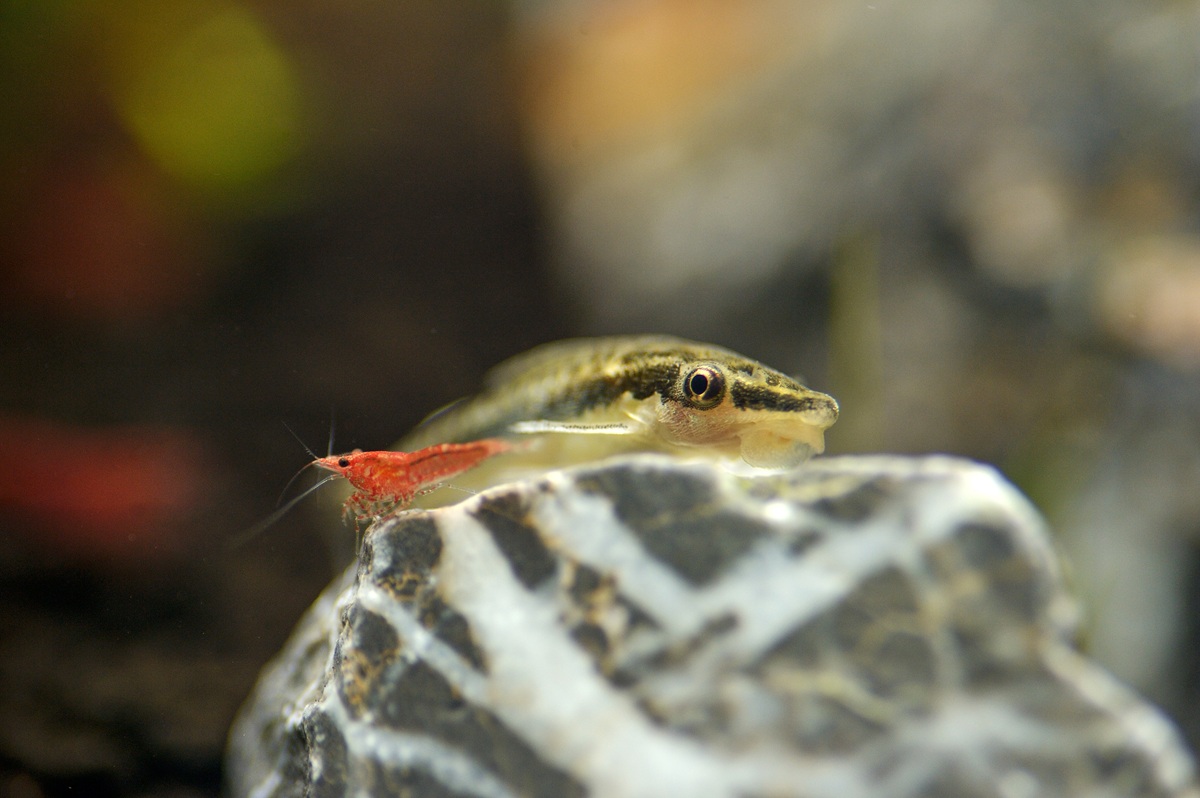
Setting up an Otocinclus and shrimp aquarium
When planning a community aquarium, it's important to consider whether the species you'd like to keep are compatible in all respects. We've already confirmed that Otocinclus catfish and shrimp work well together in terms of temperament. What about the rest?
Tank size
As you probably know, hardy Neocaridina (cherry) shrimp can do well in aquariums of 5 gallons or even smaller. The same doesn't go for Otocinclus catfish, which are slightly more active and significantly more sensitive; these ultra-nano tanks are too prone to water quality swings to keep a group of Otos alive in the long run.
Many sources still list 10 gallons as the minimum for Otocinclus, but we'd highly recommend at least 15-20, especially if you're a beginner. As an added bonus, this will give you space for almost infinite numbers of shrimp!
Water parameters
Otocinclus catfish are naturally found in both blackwater and clearwater environments. Thanks to their low mineral and high organic content, these South American waters (Amazon, Paraná, Orinoco tributaries) are invariably soft and mildly acidic, which matches well with our shrimps' needs. Bee shrimp and bamboo shrimp also like soft and somewhat acidic water, while the sturdier cherries, ghosts, and Amanos will adapt without issue.
The one parameter whose "sweet spot" is a little harder to find is temperature. Otos are decidedly tropical, while shrimp prefer their water below 75°F. Still, there is overlap — just be sure to regularly check the thermometer to make sure everything is still in order.
- pH: 6.5–7.0
- Temperature: 71.5–75°F
- GH: 4–6 dGH
- KH: 2–3 dKH
- TDS: 100–150 ppm
Please note: Stable water parameters are much more important than perfect water parameters. Causing a rapid swing to get the pH reading down, for example, will kill both your shrimp and your catfish quicker than it simply being a little too high.
Decorations
Wild Otocinclus catfish are found along river margins and in smaller, slow-flowing streams. They don't do well out in the open, instead preferring areas strewn with vegetation and leaf litter. Aside from offering cover, these double as food sources: the Otos scrape biofilm and algae off any surface they can find, including leaves and plant roots.
All this means that in terms of tank decor, these catfish will again get along swimmingly with your shrimp. Both like plenty of cover and would probably be happiest in a jungle-type aquascape — so much biofilm! Try a few live plants (especially moss for baby shrimp to hide in), some driftwood, and a layer of leaf litter. You can finish your scape with one or two assorted hides like shrimp cubes, which both critters will appreciate.
Substrate isn't much of a concern, although we prefer something rounded that won't hurt the Otos' bellies if they decide to rest on it. The shrimp don't mind either way.
Frequently asked questions
Otocinclus in the wild are found in small to very large groups. Depending on the season, it's not unusual for thousands of these catfish to congregate in the same place! In your aquarium, they'll do best in groups of at least 6 fish; if you've got space to spare, more Otos is never a bad thing.
Conclusion
If your shrimp are looking a little lonely, Otocinclus catfish might just be the perfect tankmates. Despite their differences, as long as you find the water parameter and temperature "sweet spots", these critters will cohabit peacefully for years to come.
Sources & further reading
Delapieve, M. L. S., Lehmann A, P., & Reis, R. E. (2017). An appraisal of the phylogenetic relationships of Hypoptopomatini cascudinhos with description of two new genera and three new species (Siluriformes: Loricariidae). Neotropical Ichthyology, 15(4), e170079.
Lehmann, A. (2006). Otocinclus batmani, a new species of hypoptopomatine catfish (Siluriformes: Loricariidae) from Colombia and Peru. Neotropical Ichthyology, 4, 379-383.
Schaefer, S. A. (1997). The Neotropical cascudinhos: systematics and biogeography of the Otocinclus catfishes (Siluriformes: Loricariidae). Proceedings of the Academy of Natural Sciences of Philadelphia, 148, 1-120.