


 Shrimp
 Fish
Fish Crab &
 Plants
 Foods
Foods Snails
Harlequin Rasbora Care | The Best Schooling Nano Fish?
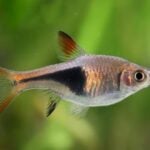
Looking for a small but pretty schooling fish for your (shrimp) aquarium? There's a reason the classics are classics: they rarely disappoint. That's why we love the harlequin rasbora! Tiny, well-behaved, and striking to look at thanks to its shimmering copper tones and dramatic black markings, this Southeast Asian native has been present in the hobby for over a hundred years — for good reason.
Sound good? Find out everything you need to know about harlequin rasboras and how to keep them below.
| Scientific name | Trigonostigma heteromorpha |
| Common names | Harlequin rasbora |
| Difficulty level | Easy |
| Origin | Malay Peninsula, Indonesia |
Table of Contents
What’s a harlequin rasbora?
Description
Say hello to an absolute staple of the aquarium world! The harlequin rasbora was first described in 1904 (as Rasbora heteromorpha) and has been ubiquitous in the hobby ever since. Aquarists appreciate its small size, dramatic appearance, flexibility and mellow nature; it works as well in community tanks as it does in carefully tended aquascapes.
Harlequin rasboras reach no more than 1.8" or so in length, making them true microfish. You can recognize the wild form by its color, which starts out a muted orange-pink near the head and intensifies into a beautiful coppery orange near the tail. The back half of the oval body features a large, striking black marking with an elongated triangular shape. This is where the fish got its name from — the marking does look a little like the triangles on an old-fashioned harlequin suit.
Having said all this, aquaculturists have done with harlequin rasboras what they've done with most other popular aquarium fish: change their looks. Through selective breeding of fish with certain genetic mutations that alter their appearance, they've managed to create long-finned harlequins, purple/blue and gold harlequins, "blond" harlequins (which lack the triangle), and probably other morphs we haven't even heard of yet.
Tip: The harlequin rasbora has a few doppelgängers, notably the slightly smaller Trigonostigma espei or lambchop rasbora. You can tell it apart from today's subject by the thinner black marking on its side. The less common T. hengeli and T. truncata also look very similar. No problem if you pick up the "wrong" rasbora, though: their care requirements are the same, and they'll even school together. Some people now take the harlequin rasbora denomination to refer to the entire genus Trigonostigma, which isn't a bad way to approach this mess of fish.
Natural habitat
Harlequin rasboras are naturally found in Southeast Asia. They inhabit (peat) swamps in the Malay Peninsula (southern Thailand, Malaysia, Singapore), and are also found in some parts of Indonesia. Their true range is contested — those doppelgängers mentioned above don't just make things more confusing for aquarists, but also for researchers and taxonomists! One Thai population was redescribed as T. truncata in 2020, and the "harlequins" in Borneo may be a different, undescribed species.
Anyway, even if the harlequin rasbora's range hasn't quite been cleared up yet, we do know what kind of habitat it likes best. It's almost always found in small forest streams, where it sticks to densely vegetated pools and other slow-flowing sections rather than braving the rapids. The water in these swampy forest pools and rivulets is mostly clear, though decomposing tree debris can give it a yellow or brownish tint.
Your harlequin rasbora aquarium
Requirements
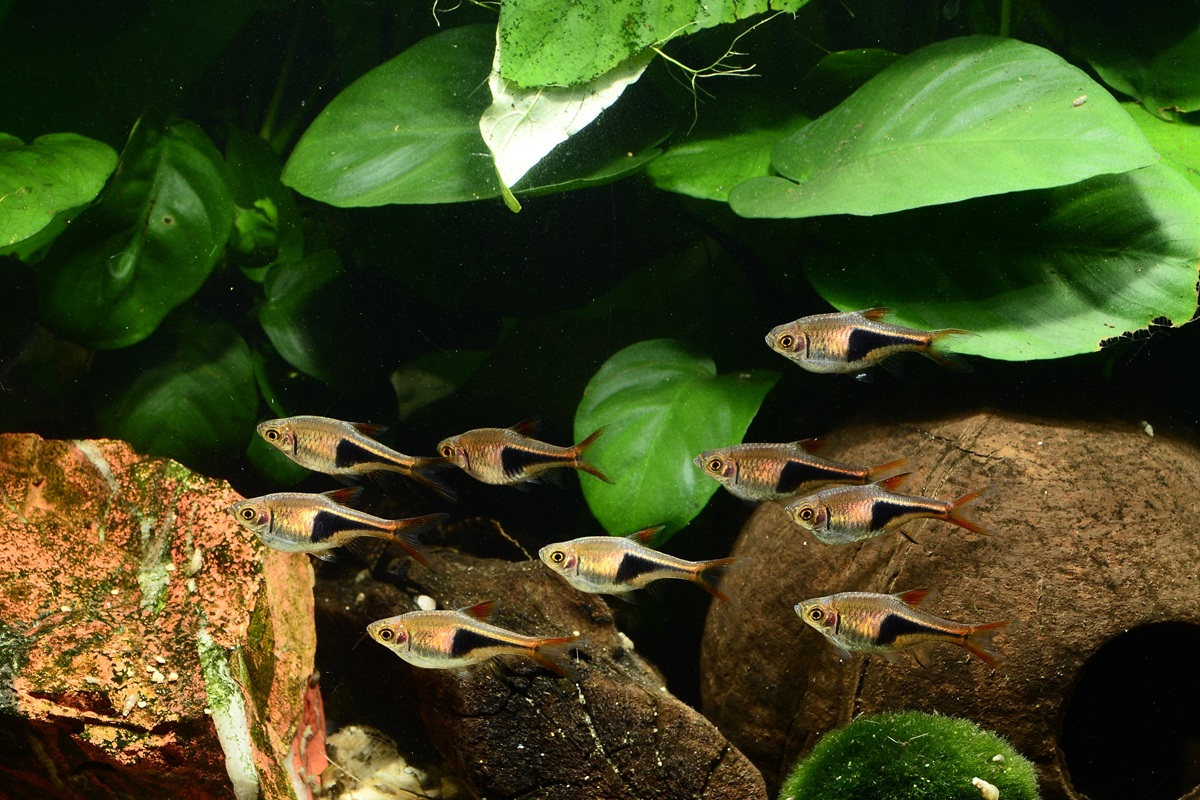
Given their small size, harlequin rasboras don't need a lot of space to thrive. A 15-gallon (long) tank should be enough for a small to medium-sized group, while 20–30 gallons really allows you to go all-out with a spectacular display of twenty or more fish. The rasboras aren't picky about decor, though it's a good idea to keep in mind that they inhabit shaded forest streams with dense aquatic or marginal vegetation in the wild. They don't like overly bright lighting or a bare environment.
If you're looking for a fun aquarium project to sink your teeth into, Southeast Asian swamps and forest streams are among the easiest biotopes to imitate. You can have your harlequins rasboras living like they would in the wild by covering a sandy substrate with a layer of leaf litter, sticks, and seed pods and densely planting it with Southeast Asian plants like Cryptocoryne, Hygrophila, Blyxa, and Nypmhaea water lily. The water will turn slightly yellow from the botanicals.
If you need more biotope inspiration, you can find a video of harlequin rasboras in their natural habitat here.
Water parameters
Wild harlequin rasboras can be found in soft and lightly acidic waters and probably won't do well in a more alkaline environment. Our tank-bred fish, though? Those are super-flexible and will thrive in a range of parameters as long as the aquarium is properly cycled and mostly stable. Provided that you keep the water clean, they're forgiving of beginner mistakes and occasional fluctuations — another reason they make an excellent choice for your first-ever aquarium.
pH: 5.0–7.5
Temperature: 70–82.5°F
TDS: 20–200
Tankmates
Harlequin rasboras are ideal community fish. Tank size permitting, they can live with any well-behaved species that thrives in similar water parameters and doesn't have a taste for small fish. There are too many options to name here, but you can choose between a wide range of small tankmates from the rasboras, tetras, danios, livebearers, catfish, loaches, dwarf cichlids, labyrinth fish, small rainbowfish and more.
Don't forget that harlequin rasboras also need the presence of their own kind. "The more, the merrier" definitely applies here: a group of six or eight is okay, but twenty or even thirty fish will really stop anyone who walks by your aquarium in their tracks. They school quite tightly, their shimmering copper bodies moving in perfect coordination. When kept alone or in very small groups, on the other hand, they can become skittish and secretive.
If you did decide to go for that Malay swamp biotope, you've got a staggering number of biotope-accurate tankmates to choose from. Malaysia in particular is very much on top of tracking their local aquatic biodiversity. The various surveys available (see the sources at the bottom of this care guide) contain loads of compatible aquarium species that your harlequin rasboras might have come across had they been born in the wild:
- Dwarf rasbora (Boraras maculatus)
- Brilliant rasbora (Rasbora einthovenii)
- Blackline rasbora (Rasbora borapetensis)
- Croaking gourami (Trichopsis vittata)
- Malayan forest Betta (Betta pugnax)
- Chocolate gourami (Sphaerichthys sp.)
- Five-banded barb (Desmopuntius pentazona)
- Pearl gourami (Trichopodus leerii)
- Kuhli loach (Pangio semicincta)
- Forest halfbeak (Hemirhamphodon pogonognathus)
How's that for variety? We'd struggle to choose who to include in our biotope set-up!
What about shrimp? Yes, harlequin rasboras and shrimp get along swimmingly. Sure, all fish want to make a dinner out of our favorite crustaceans — but harlequins are much too small to try to take on an adult shrimp, even if it's a tiny Neocaridina. Only newly hatched babies are at risk, and you can easily protect those by densely planting the tank. Fancy bee shrimp? Maybe not, but cherries, crystal reds, Amanos and the like should work well.
Harlequin rasbora diet
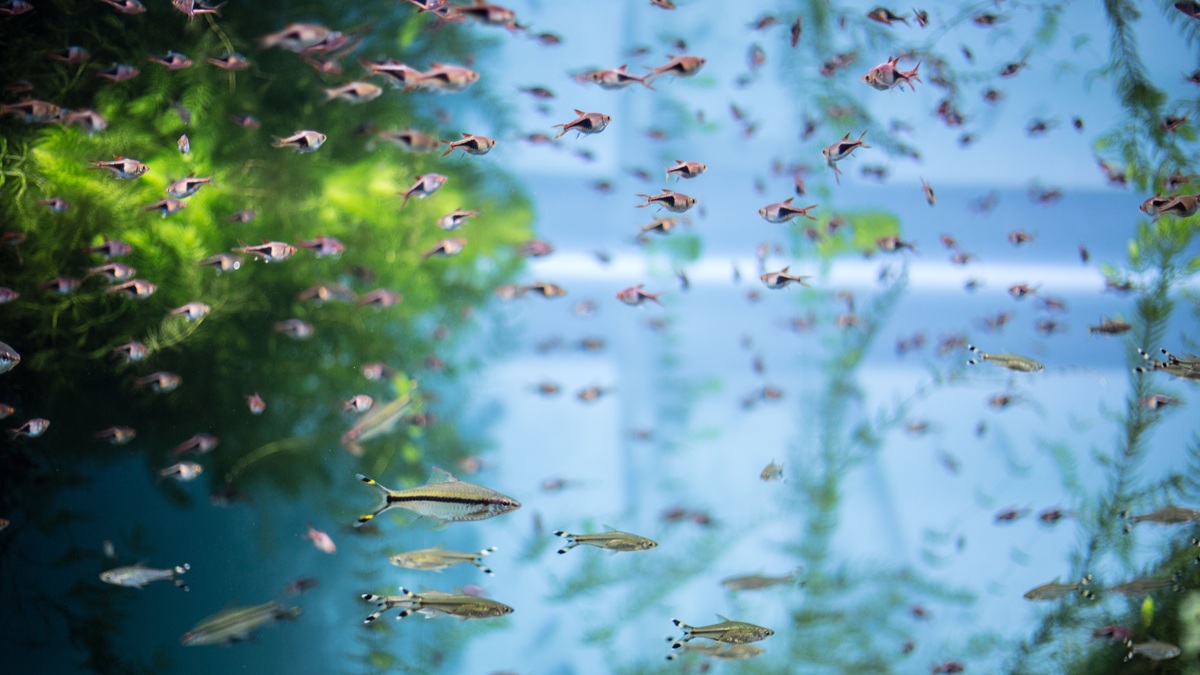
Like most small schooling cyprinids, wild harlequin rasboras mostly eat bugs. In the aquarium, they're unfussy and will accept anything they can fit into their mouths. You can feed a high-quality microfood (pellet or flake) as a staple, though it's also a good idea to regularly mix things up with (thawed) frozen foods or live foods. Variety is the spice of life!
Breeding harlequin rasboras
Like other cyprinids — pretty much all small schooling fish aside from the livebearers — harlequin rasboras are egg scatterers. Their only involvement with their offspring is in creating them; the sticky eggs are adhered to fine-leaved plants and left to fend for themselves. In the aquarium, the rasboras will even try to eat their own eggs and babies! Still, in densely planted tanks you might just find your harlequin rasbora population slowly growing all by itself.
If you want to maximize the survival rate and breed these rasboras to sell or use in your other tanks, it's a good idea to set up a separate spawning and rearing container. We're working on a breeding guide for egg-scattering fish as we speak, so check back in a few days if you want to know how to magically turn a few harlequins into many.
Buying harlequin rasboras
Given their immense popularity, you should be able to find harlequin rasboras at most aquarium stores. Do make sure the fish you're buying are healthy — they're bred on a massive scale, and because they're so cheap to buy, not always afforded the care they need. Their color usually improves a lot once they've spent a few weeks destressing in your aquarium, but you should avoid harlequins that look lethargic or emaciated.
If you don't want to leave your home to buy aquarium fish, you can also order them online! We are proud to offer you our beautiful, healthy harlequin rasboras here at The Shrimp Farm, shipped right to your doorstep with live arrival guarantee.
Sources & further reading
Abdullah, F. (2012). Ecology of Fishes in Tasek Bera, Pahang, Malaysia. University of Malaya (Malaysia).
Fahmi-Ahmad, M., Halim, M. R. A., Ilham-Norhakim, M. L., Arshad, M. N. A., Zakaria, Z. A., Ghani, I. F. A., ... & Zain, K. M. (2024). A Preliminary Checklist of Fish Species in the Peat Swamp Forest of Ayer Hitam Utara State Park Forest, Johor, Malaysia. Pertanika Journal of Tropical Agricultural Science, 47(1).
Hui, T. H. (2020). Trigonostigma truncata, a new species of harlequin rasbora from Malay Peninsula (Teleostei: Danionidae). Raffles Bulletin of Zoology, 68.
IA, A., & YB, E. (2021). Provisional Checklists on Blackwater Fish from the Peat Swamp in Terengganu, West Coast of Peninsular Malaysia. Egyptian Journal of Aquatic Biology & Fisheries, 25(6).
Sholihah, A., Delrieu-Trottin, E., Sukmono, T., Dahruddin, H., Risdawati, R., Elvyra, R., ... & Hubert, N. (2020). Disentangling the taxonomy of the subfamily Rasborinae (Cypriniformes, Danionidae) in Sundaland using DNA barcodes. Scientific reports, 10(1), 2818.
Yu Abit, L., Kamaruddin, I. S., Mohd-Rozhan, Z., Ina-Salwany, M. Y., & Mustafa-Kamal, A. S. (2012). Fish biodiversity survey (2009) of streams in the Ayer Hitam forest reserve, Puchong, Selangor. Pertanika J. Trop. Agric. Sci, 35(1), 15-19.