

 Shrimp
 Fish
Fish Crab &
 Plants
 Foods
Foods Snails
Blue Eye Lemon Bristlenose Pleco (L144) | Caring for Your Leucistic Ancistrus
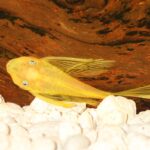
Looking to add a bristlenose pleco to your tank? Why not make it a leucistic one! The blue eye lemon bristlenose pleco is the same Ancistrus catfish we all know and love, but with a beautiful golden hue and bright blue eyes. Find out about the origins of this striking pleco and how to care for yours below.
| Scientific name | Ancistrus sp. |
| Common names | L144, lemon bristlenose pleco |
| Difficulty level | Easy |
| Natural range | Lowland rivers in South America |
Table of Contents
Blue eye lemon bristlenose pleco origins & appearance
Will the real L144 please stand up?
Why is this catfish called L144, lemon bristlenose pleco, and Ancistrus sp.? Wasn't one name enough? Welcome to the wonderful world of loricariid catfish, where confusion reigns supreme. It's incredibly difficult to tell which catfish is which, even for experts in the field, so the numbering system was introduced in an attempt to create at least some form of order.
In the case of L144, this attempt failed. The real L144 originated from a single fish with a mutation for light golden coloring (leucistic), found in a shipment from Paraguay to Germany in the early 90s. It was bred and did produce golden offspring, but the line eventually died out. A similar-looking version of the ubiquitous bristlenose Pleco, Ancistrus cf. cirrhosus (itself a contested species) popped up in the hobby in the early 2000s — and was promptly named L144 again. Planet Catfish attempts to straighten the situation out by referring to it as Ancistrus sp. 4, but we're not sure if adding more numbers is necessarily helpful.
Different fish, same name: we'll compromise by calling it the false L144, or just the lemon bristlenose pleco. The origin of the lemon bristlenoses in the aquarium hobby is impossible to trace, but we can assume they originate from varied South American lowland river systems. Factors like flow level and black or clear water probably vary, but given these are cave breeders, we can assume plenty of rocks and driftwood.
Appearance
The color mutation in bristlenoses known as "lemon" comes in two versions, one with black and one with bright blue eyes. This sets them apart from the red-eyed albino Ancistrus. All are a lovely golden color, sometimes with random black spots — some catfish enthusiasts don't like this extra pigmentation, but we think it adds to their looks. The fins are long and flowy, especially when the fish is still small.
As with all bristlenose plecos, both male and female lemons can grow bristles. It's the boys whose "face antlers" grow the longest and bushiest, however. They are also larger, reaching up to 4" in length (compared to max. 3.5" for the females).
Setting up a blue eye lemon bristlenose pleco aquarium
Requirements
Although a 4" catfish doesn't sound all that big, a 20-gallon long aquarium is the minimum recommended for a single bristlenose pleco because Ancistrus are high-waste fish. Go smaller and you'll be stuck doing 24/7 water changes once your fish reaches adulthood, as well as putting the nitrogen cycle and any tankmates at risk.
You can keep a pair of lemon bristlenoses in a 30-gal long system if it's not too heavily stocked; multiple pairs will need significantly more space, because the males do tend to squabble over territory. Given that these catfish mostly stay close to the substrate, rarely visiting the rest of the tank, a long aquarium is preferable.
Bristlenoses are highly adaptable and will do well in both clear and tannin-stained water, low and high flow, and planted and unplanted tanks. Their only demands are easy to meet: a few caves or tubes, a good chunk of driftwood and some smooth rocks to munch and rest on, and well-oxygenated water. You can use both sand and gravel, though keep in mind that pleco bellies don't feature the same armor their backs do. This means a smooth substrate works best.
Water quality
All lemon bristlenose plecos are tank-bred, which makes this already flexible fish even more adaptable to a wide range of water parameters. The tank should of course be fully cycled, and regular water changes are a must with these "poop machines", but the majority of aquarists should be able to keep theirs in conditioned tap water just fine.
Remember, stability is more important than perfect parameters — and water tests are your best friend.
Temperature: 22–28°C (~71.5–82.5°F)
pH: 6.0–7.5
TDS: 20–250
Tankmates
Bristlenose plecos like the lemon bristlenose are among the most popular aquarium fish, thanks in large part to their mellow personalities. Although males will react fiercely to each other (and anything else that looks like themselves), they mind their own business otherwise. Baby shrimp may be eaten if they get too close to the pleco's mouth, but losses should be minimal. This means you can keep these catfish with fast-breeding shrimp like Neocaridina just fine.
As for other tankmates, you're pretty spoiled for choice. You can opt to go for a fully peaceful community, or (if you don't keep shrimp) try something spicier. South American cichlids work well: they couldn't bother these well-armored catfish if they tried. In fact, given that bristlenoses mostly sit quietly on their favorite log or rock, we doubt most of their tankmates even realize they're there!
Blue eye lemon bristlenose pleco diet
The main reason bristlenose plecos are so well-behaved is that they simply have no need to chase anyone around to eat them. As their sucker-shaped mouths reveal, they instead obtain their meals by scraping hard surfaces like rocks and driftwood. This makes their natural diet similar to that of our ornamental shrimp: they feed on biofilm ("aufwuchs"), that slimy layer consisting of algae and other microorganisms that eventually covers all underwater surfaces.
We have to note that although bristlenose plecos are sometimes sold specifically as algae eaters, keeping your aquarium looking nice is your job, not theirs. Most will indeed munch on some algae here and there, but don't expect your fish to act as a built-in aquarium Roomba.
In our clean home aquariums, your pet catfish will of course need daily supplemental meals. A high-quality, sinking dry food for omnivores works well as a staple, but be sure to regularly switch it up. (Thawed) frozen foods like bloodworms, blanched fresh veggies, algae tablets, and gel foods will all be much appreciated.
Breeding the blue eye lemon bristlenose pleco
Never bred a fish before? No worries, you can breed this one! In fact, calling it "breeding" is a bit excessive — the dad fish takes care of the child-rearing. All you have to do is provide the pair and their offspring with a comfy home. In fact, in densely planted set-ups, baby plecos might appear without any intervention on your part.
If you want to ensure maximum survival of the fry, you can set up a dedicated breeding operation. It's not a must, though, because a nice cave in the display tank usually does the trick eventually.
Blue eye lemon bristlenose pleco ingredients:
- 1M 1F adult fish (1+ year old, healthy and well-fed)
- 15-gallon long breeding tank or tub (seeded/cycled)
- Pleco-appropriate water parameters (neutral pH works well)
- 2-3 pleco caves
- Rich, high-protein foods (frozen foods and fresh veg)
Blue eye lemon bristlenose pleco recipe:
- Give the fish some time to settle in. The male needs to inspect the caves and claim his territory.
- When all is ready, perform a large (30-40%) water change with slightly cooler water. This simulates the rainy season, during which bristlenoses breed. You may have to repeat this in a week or so.
- Sit back and observe. The male will lure the female into his cave, where she'll stay for a couple of days to lay eggs.
- Some people remove the female from the breeding tank once she exits the cave, just to make sure she doesn't bother the male during his parenting duties. This is optional.
- Do nothing aside from regular water changes EXCEPT if the male abandons or begins to eat the eggs. This can happen with first-time dads. You can rescue the eggs by placing them in a breeding box inside the same tank, preferably with an airstone nearby but not pointed directly at them.
- If the breeding attempt was a success, you'll spot tiny wriggling babies inside the cave after a few days. No need to feed just yet, because they still have their yolk sacs to finish. Just keep the tank clean.
- Once the fry venture out, you can begin supplementing the parents' usual foods with powdered (algae-based) food. This stuff makes a mess, so test and change 25-30% of the water daily.
- Keep up the feeding and the cleaning. Once the fry are about the size of a finger — their growth rates vary — they can go in the display tank or be sold.
Congrats, you've cooked up some beautiful catfish!
Buying a blue eye lemon bristlenose pleco
Given that you've got both "L144" and albino morphs to choose from, finding a golden bristlenose pleco shouldn't be too difficult. You may even be able to buy from a fellow hobbyist.
Those striking blue eyes in particular are a little trickier to find — you can ask your LFS to order a few in for you, or buy online. We are proud to offer you our beautiful blue eye lemon bristlenose plecos! Shipping to your doorstep with live arrival guarantee.