


 Shrimp
 Fish
Fish Crab &
 Plants
 Foods
Foods Snails
Black Neon Tetra Care | Have The Tetras Gone Goth?
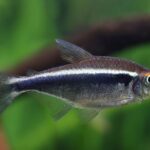
Who's that fish who looks like the neon tetra's emo cousin? The black neon tetra, of course! If you're looking for less jewel tones and more visual drama for your (shrimp) tank, this underappreciated little shoaling fish might be just the thing. It's hassle-free, peaceful, and beginner-proof — what more could we ask for? Find out how to care for your black neon tetras below.
| Scientific name | Hyphessobrycon herbertaxelrodi |
| Common names | Black neon tetra |
| Difficulty level | Easy |
| Natural range | Paraguay River basin |
Table of Contents
Black neon tetra description & origins
Description
Black neon tetras are your typical small schooling fish. They sport a torpedo-shaped body that grows to around 1.5" in length, with the males staying a little smaller than the females. Their base color consists of a slightly transparent silvery hue, but thanks to the two lateral lines — one white, one stark black — plus the distinctive orange "halfmoons" on their eyes, these tetras are far from boring to look at. A school of 10+ black neons, with those sparkling white stripes, is in fact pretty mesmerizing!
Despite their highly similar appearance, neon (and cardinal) tetras aren't that closely related to black neon tetras. "Regular" neons belong to the genus Paracheirodon, while the gloomy edition is known as Hyphessobrycon herbertaxelrodi — it was named after the founder of Tropical Fish Hobbyist Magazine, Herbert Axelrod, who ran its initial description in his publication. All these little South American shoaling fish do belong to the same family: the Acestrorhamphidae or American tetras (formerly Characidae).
It's likely many species of tetra sport similar horizontal neon stripes because this pattern helps them keep an eye on the rest of their school, which would explain why these bars show up in fish from all sorts of different habitats. One 2009 study also links the neon tetra's stripe to predator evasion, supposing it throws a reflection on the water surface that may cause striking predators to miss the mark.
Origins
Like so many of our favorite aquarium species, black neons are naturally found in tropical South America, in this case the Paraguay River basin. You won't find them in the main river, though: they favor smaller headwaters, tributaries, and seasonally flooded ponds and streams. They're a common sight in the Pantanal, the world's largest tropical wetland area that stretches from Brazil into Bolivia and Paraguay.
Unlike neon tetras, black neons are not blackwater specialists. The waters they inhabit range from tannin-stained to brownish to crystal clear and usually contain a wide variety of aquatic and riparian plants.
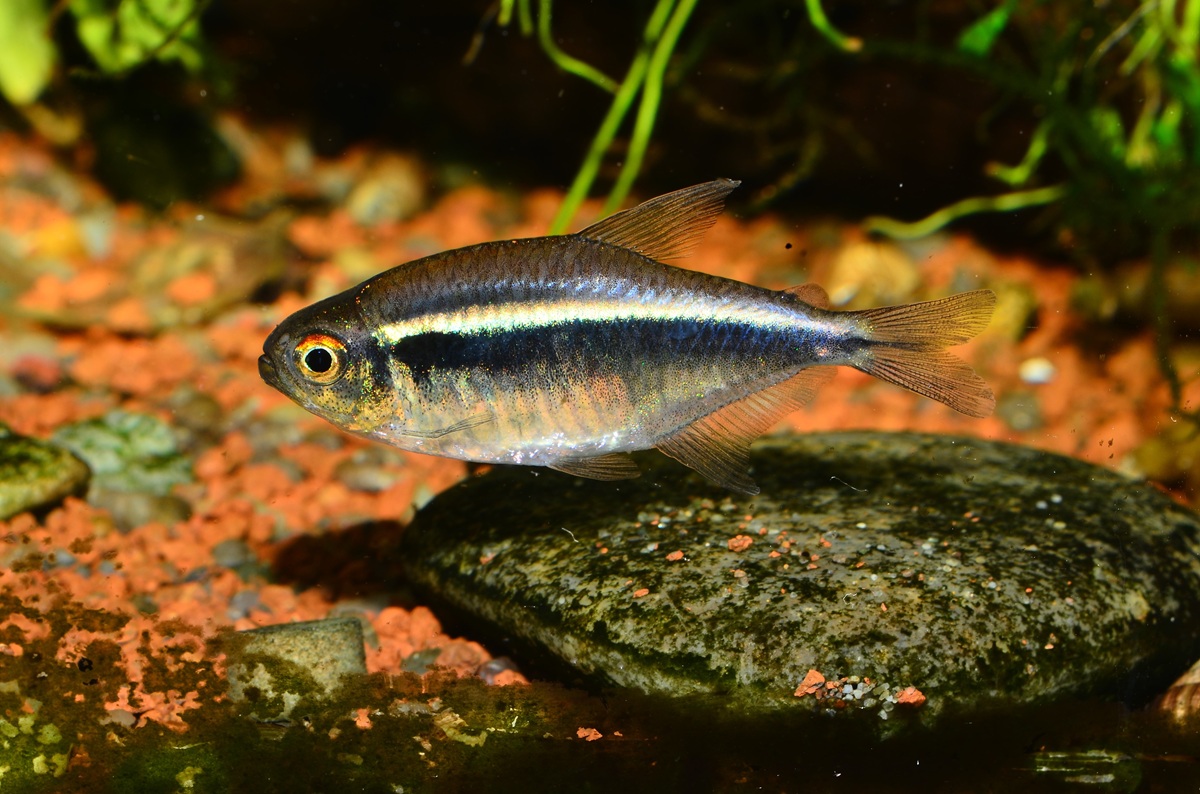
Your black neon tetra aquarium
Requirements
A black neon tetra doesn't need much to be happy. Clean water and plenty of friends will get it most of the way there! Add a few live plants, rocks, and pieces of driftwood along the edges to help it feel sheltered from potential predators — leaving some open swimming space in the middle — and you're golden. Substrate isn't much of a concern for the tetras, although something soft and sandy will work well if you want to keep bottom dwellers like corydoras catfish.
Keep the point about friends in mind when you choose your black neon tetra aquarium. Although a single black neon is small, they are active swimmers. Copy and paste that ten times, and you're looking at a minimum of 20 gallons (long) for a group, ideally more.
Water quality
When a fish is naturally found in a wide range of habitats — different bodies of water with different conditions — it's usually good news for us aquarists: it means they're flexible. The black neon tetra is no exception! In fact, it's usually considered hardier than neon tetras, which can be surprisingly fragile for such a popular aquarium fish. Some of this is probably because neon tetras are commercially bred on a massive scale, which often means inbreeding and weak genetics, but they're also likely just not as hardy on account of being blackwater specialists.
Anyway: if you're a first-time aquarist, try the black neons. They still need a fully cycled aquarium and regular water changes, but are less prone to mystery deaths. You're unlikely to run into trouble as long as the pH and water hardness stay low to moderate.
Temperature: 68–82 °F
pH: 5.0–7.5
Hardness: 20–200ppm
Tankmates
As we've mentioned, black neons are schooling fish. They can be spotted in large groups in the wild, and they've even got that special stripe to help them recognize their own kind. Keeping them alone or in very small groups makes these fish feel unsafe and stressed, meaning you won't see much of their natural behavior and they're more prone to falling ill. That's why we recommend keeping no less than six black neons, preferably at least ten. If you really want them to shine, a large aquarium with 30+ black neon tetras, which will school pretty tightly, is a fantastic sight to see.
Black neon tetras also make excellent community fish. Although you should avoid keeping them with larger predators (which will gladly have tetra for breakfast) and slow-moving, long-finned fish like guppies (which may be nipped at), many of the other species found at your local fish store will get along fine with Hyphessobrycon. Your best choices are other small schooling fish, small catfish, and small cichlids. Examples include:
- Corydoras catfish
- Otocinclus catfish
- Other tetras: cardinals, neons
- Small rainbowfish
- Ramirezi cichlids
- Kuhli loaches
- Dwarf, honey, or sparkling gourami
One great thing about black neon tetras is that they make an excellent schooling fish for an easy South American biotope system. The species can be found alongside a bunch of other aquarium classics in the wild, including Otocinclus and bronze corydoras catfish. Plants are also a breeze: get some Amazon sword, Ludwigia or Bacopa stem plants, and a bunch of Sagittaria, and you've got a pretty realistic jungle stream going on right in your own home!
Can I keep black neon tetras with shrimp?
As with most small schooling fish, the answer is yes. Black neons won't bother larger shrimp like Amanos and ghost shrimp, and will also work well alongside a colony of fast-breeding cherries or other Neocaridina. They will eat baby shrimp when given the chance, but densely planting the tank (moss in particular works well) helps ensure those chances stay few and far between.
Black neon tetra diet
Like other tetras, black neons likely eat a variety of small bugs. Cardinal tetras have been shown to mostly feed on microcrustaceans and midge larvae, and we can expect something similar here. That means that in the aquarium, your black neon tetras will appreciate a small carnivore staple supplemented with regular frozen fare.
If you really want to see your black neons get excited about a meal, you can also get some live food like Daphnia once in a while, or even maintain your own ongoing colony.
Buying black neon tetras
Black neons have never been anywhere near as popular as their distant red-and-blue cousins, but luckily, that doesn't mean they are difficult to find. Despite no one ever really paying attention to this species, most aquarium stores will carry them or be able to order them in for you. That includes us! We'll ship your black neon tetras straight to your doorstep with live arrival guarantee.
Sources & further reading
Ikeda, T., & Kohshima, S. (2009). Why is the neon tetra so bright? Coloration for mirror-image projection to confuse predators? “Mirror-image decoy” hypothesis. Environmental biology of fishes, 86(3), 427-441.
Rincón, L., Redondo, F., Kobrinsky, W., Pandolfi, M., & Pozzi, A. G. (2023). Morphological study of the digestive tract of the cardinal tetra, Paracheirodon axelrodi (Characiformes: Characidae). Neotropical Ichthyology, 21, e220092.
Seehausen, Mayhew, & Alphen, J. V. (1999). Evolution of colour patterns in East African cichlid fish. Journal of evolutionary biology, 12(3), 514-534.