


 Shrimp
 Fish
Fish Crab &
 Plants
 Foods
Foods Snails
Cherry Barb Care | A Splash of Scarlet for Your Tank!
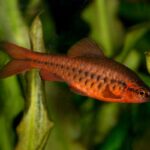
Ever steered clear of a barb at your local aquarium store because you were told they're all nippy bullies? The cherry barb begs to differ! This stunning scarlet gem from southern Sri Lanka is actually one of the mellowest, not to mention one of the most flexible, schooling fish for the freshwater aquarium.
Beginner-proof and unproblematic, this is one barb you'll love keeping and even breeding your community tank. Below, let's find out what it needs to thrive.
| Scientific name | Rohanella titteya |
| Common names | Cherry barb |
| Difficulty level | Easy |
| Origin | Sri Lanka |
Table of Contents
What’s a cherry barb?
Description
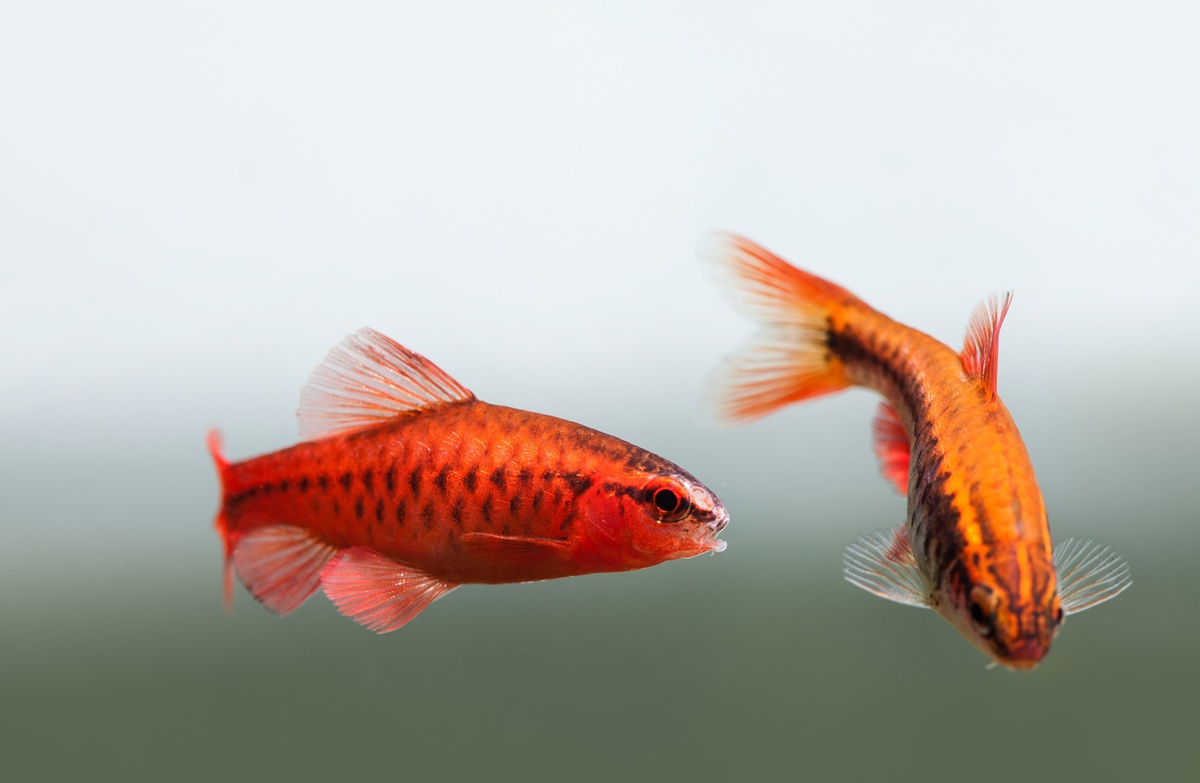
The cherry barb may be small, but it doesn't compromise on looks. The males are a bright, cherry-red with black accents and mustache; the females are a more muted bronze-ish, but still look stunning thanks to their double lateral line (black with a fainter yellowish to pinkish line above it) and darker "accent scales". Both will become even more vibrant when ready to breed.
At a maximum length of only 2" or so, cherries are pretty small as far as barbs go. They're highly appreciated in the aquarium hobby thanks to their flexible, forgiving nature and — maybe more importantly — the fact that they don't nip at their tankmates. Tiger barbs and other nippers have given barbs as a whole a bad reputation, but you won't have to worry about your cherries bothering your other fish.
Did you know? If you've been an aquarist for a while, you'll likely know cherry barbs as Puntius titteya. Taxonomists have been slowly resolving the mess that was the "wastebasket taxon" of Puntius, with the cherry barb's turn coming in 2023. It's now the only member of its very own genus: Rohanella.
Natural habitat
Cherry barbs are native to the South Asian island country of Sri Lanka (formerly Ceylon). They only occur in the southwest, which features a climate typical for many of our favorite tropical fish: warm and wet. The barbs can be found in small, shallow, slow-moving streams in the lowland tropical rainforest. These waters feature clear to slightly tinted (from decaying plant material) water, usually with a sandy substrate covered in leaves and other debris.
Unfortunately, the cherry barb's natural habitat is declining — as is the size of the wild populatio. Because their range in southern Sri Lanka is so limited and mostly outside protected areas, they face an incredible number of threats. The IUCN Red List now considers the species to be Vulnerable, listing issues like invasive species, hydropower projects that divert waterways, pollution from urbanization and agriculture, mining, deforestation, and general habitat loss.
Overharvesting for the aquarium trade is also a problem for wild cherry barbs, though luckily, the fish you'll find at your local aquarium store in the USA are almost always tank-bred.
Your cherry barb aquarium
Requirements
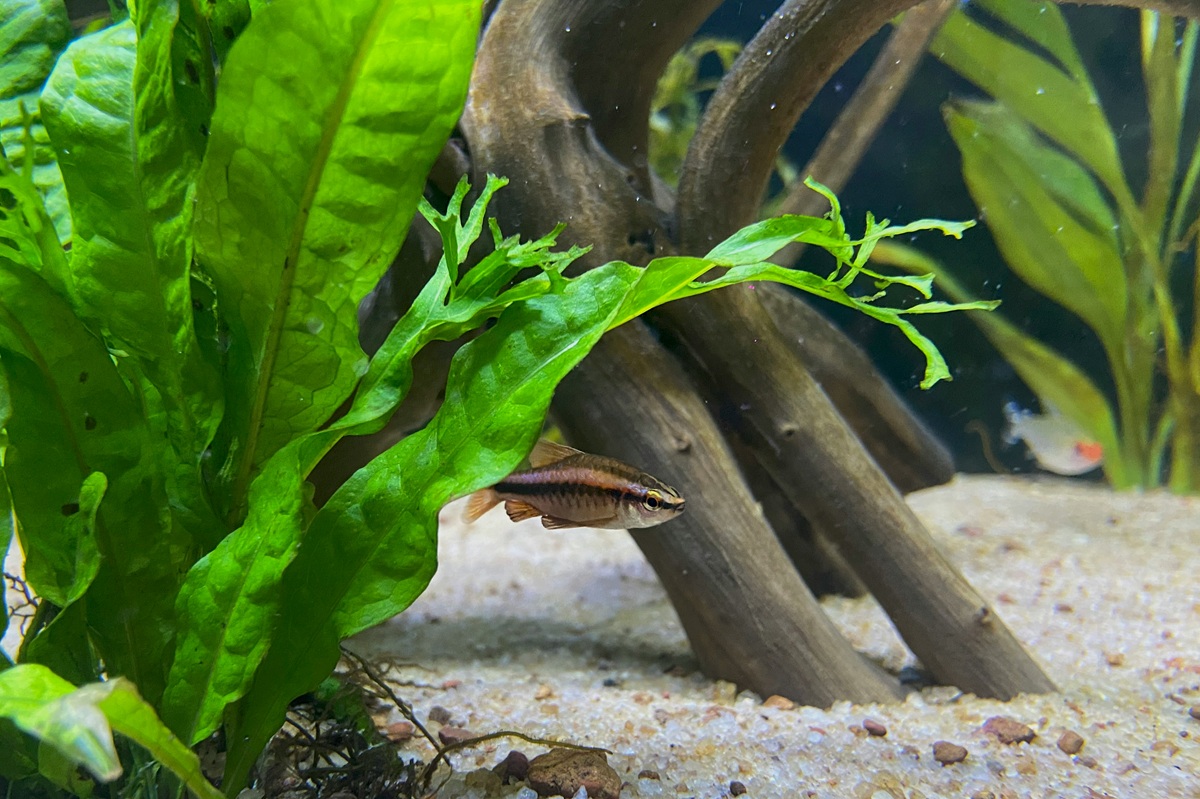
Given that it's one of the smallest species of barbs in the aquarium trade — the comparable rosy barb reaches almost triple the length — you don't need a huge tank to keep a group of cherry barbs. A twenty-gallon (long) aquarium can comfortably house a small group while still leaving space for one or two tankmates. Any kind of decor works, though we do feel like their lovely reds pop best against a dark backdrop of live plants and driftwood. Some degree of water flow will be appreciated, though there's no need to turn the tank into a raging rapid.
If you'd like to do something really cool with your cherry barb aquarium, you can also think about setting up a Sri Lankan stream biotope. As we've mentioned, these shallow streams usually feature slow-flowing, clear water. They don't offer much in the way of aquatic plants, but have plenty of marginal vegetation around the edges that you can imitate using tropical houseplants. The substrate is silty and usually covered in a layer of leaf litter and sticks. It might sound odd to fill your tank with plant "trash", but it actually looks beautiful and very natural: your own little slice of Sri Lanka.
For more inspiration, you can find a video of cherry barbs in their natural habitat here (stream shown from the 2:00 mark).
Water parameters
The streams cherry barbs inhabit in the wild are lightly acidic, but the tank-bred specimens we get from our local fish stores in the USA are extremely flexible and will do well in a very wide range of parameters and temperatures. That doesn't mean they don't need a stable, fully cycled aquarium, but it does mean that in most areas, you'll be able to keep them in dechlorinated tap water without having to worry about pH or hardness.
pH: 6.0–8.0
Temperature: 68–83°F
TDS: 30–300
Tankmates
When it comes to flexible fish that fit into a wide range of community-type aquariums, it doesn't really get any better than cherry barbs. Because they don't care much about specific water parameters and are too large to be eaten by most small predators, they can be combined with almost all peaceful fish to be found at your local aquarium store.
We won't exhaust ourselves trying to list all the fish you can keep with cherry barbs, but all the following main groups contain good options. Just check the potential tankmate's requirements against that of the barbs to make sure they're a good fit!
- Other small barbs
- Tetras
- Rasboras
- Ricefish
- Danios
- Livebearers
- Rainbowfish
- Loaches
- Small catfishes
- Labyrinth fish
- Dwarf cichlids
Don't forget that cherry barbs also appreciate the presence of their own kind. Although they don't tend to school very tightly, they'll become skittish and washed out when kept on their own. Keep a group of at least eight fish, preferably ten or more, for the best results. This also allows you to observe their fascinating intra-barb interactions, like the males sparring and showing off for the girls during breeding time.
If you decided to go for that Sri Lankan stream biotope and want to keep your barbs with fish they might have encountered in the wild, you can try:
- Black ruby barb (Pethia nigrofasciata)
- Fire rasbora (Rasboroides vaterifloris)
- Ceylon killifish (Aplocheilus dayi)
- Giant danio (Devario malabaricus)
What about shrimp? Well, cherry barbs don't make the absolute best shrimp tankmates — they'll definitely try to eat the babies. Still, that doesn't mean it can't work. In a well-planted aquarium, you can opt for a prolific species like Neocaridina davidi (cherry shrimp) that can handle the losses. You can also consider something a little bigger that won't look like a snack to the barbs, like the algae-eating Amano shrimp.
Cherry barb diet
Studies of cherry barb diet in the wild reveal them to be omnivores with wide tastes. They eat the standard fare of aquatic insects, rotifers (a type of tiny freshwater zooplankton), and general detritus, but also specifically go for diatoms and algae. Cherry barbs as living lawnmowers?! Well, you probably shouldn't buy them as a cleaning crew, but they might help to keep your tank a little cleaner by picking at unwanted vegetation.
Your pet cherry barbs will happily eat any high-quality floating or sinking omnivore food. They'll also accept algae tablets and gel food. For the best results, you should also regularly offer frozen or — ideally — live foods like Daphnia. This especially applies if you'd like your cherry barbs to reproduce.
Tip: You may have heard barbs eat plants. Some species do indeed have a big taste for macrophytes (aquatic plants large enough to be seen with the naked eye), but luckily, the cherry barb limits itself to occasionally picking at microphytes (algae and diatoms). Another reason we consider it particularly polite as far as barbs go.
Breeding cherry barbs
Cherry barbs are egg-scatterers, which means they lay their sticky eggs on fine-leaved plants and don't have anything more to do with their offspring after. Most aquarists find them easy to breed, and your colony might actually expand all by itself in densely planted tanks. If you want more of the fry to survive, however, you'll have to set up a separate breeding tank — as with many other fish, the parents don't seem to recognize their own offspring and will gladly eat them.
Please stay tuned: we're working on a full breeding guide for egg scatterers like cherry barbs as we speak!
Buying cherry barbs
Cherry barbs are among the most popular aquarium fish (it should be clear by now why!). You'll find them cheap at most aquarium stores; pick vibrant, active fish with slightly rounded bellies. Be sure to check you're buying the right species, as rosy barbs look similar when young but can reach a comparably humongous 5+ inches. If it has a horizontal stripe, it's a cherry barb; if it has a dot, it's a rosy.
If you prefer shopping from home, you can also easily buy aquarium fish like barbs online. We're over the moon to offer you our super-bright, friendly cherry barbs, shipped straight from The Shrimp Farm to your doorstep with live arrival guarantee!
Sources & further reading
De Silva, S. S., Wijeyaratne, M. J. S., & Kortmulder, K. (1976). A comparative study of the food and feeding habits of Puntius bimaculatus and P. titteya (Pisces, Cyprinidae).
Shirantha, R. R. A. R., Wijeyaratne, M. J. S., & Amarasinghe, U. S. (2005). Food niche segregation among co-occurring endemic fish species in Sri Lanka. Sri Lanka Journal of Aquatic Sciences, 10.