

 Shrimp
 Fish
Fish Crab &
 Plants
 Foods
Foods Snails
Threadfin Rainbowfish Care | The Most Elegant Nano Fish
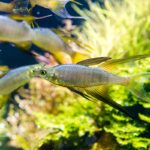
Don't you just love a fish that ticks all the boxes? The threadfin rainbowfish (Iriatherina werneri) is active, peaceful, shrimp-safe, and gorgeous to look at. And as if that wasn't enough, it's unfussy and easy to care for, too! Find out all about keeping this swimming gem in your aquarium.
| Scientific name | Iriatherina werneri |
| Common names | Threadfin rainbowfish, featherfin rainbowfish |
| Difficulty level | Moderate |
| Natural range | New Guinea, tropical Australia |
Table of Contents
Threadfin rainbowfish description & origins
Description
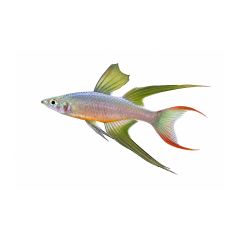
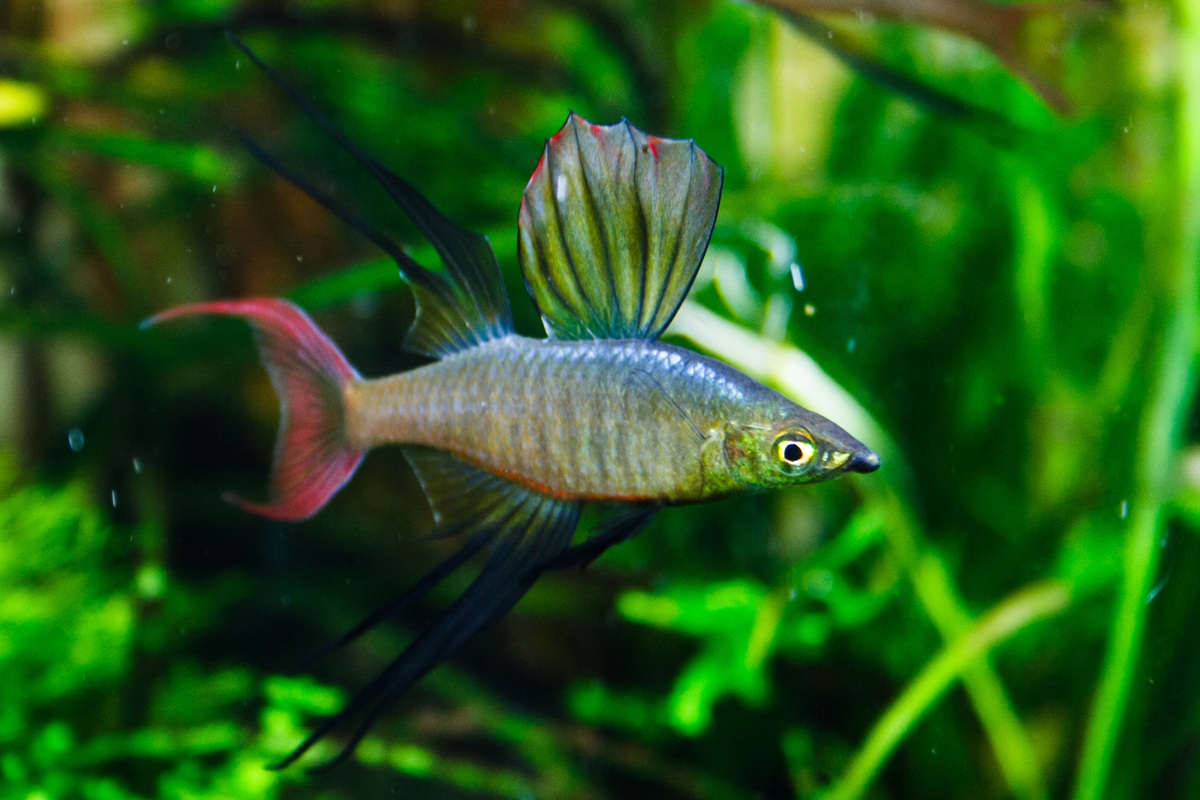
It seems good things come in small packages after all. Although threadfins reach no more than 2" in length, with most staying smaller, they're as striking as any rainbowfish. Their name is, of course, derived from the males' elongated pelvic, anal, and second dorsal fins, which are a dramatic black in color and can be almost as long as the body. Interestingly, although these long fins don't look very hydrodynamic, research shows they don't cause additional drag while swimming.
In order to impress the females, which are a lot less flashy, the males also sport extra-large first dorsal and tail fins, plus splashes of red and iridescent blue color. Quite a sight when they display for potential mates — which they do almost constantly. That's exactly why this species is such a great choice if you're looking for the kind of fish that will stop people in their tracks when they glance at your tank.
The threadfin rainbowfish is currently the only species in its genus, Iriatherina. Keep your eyes peeled, though: local populations vary quite a bit, so more official species may be described in the future.
Natural habitat
Although the fish you'll find in your local aquarium store are captive-bred, wild threadfin rainbowfish are found in the slow-flowing swamps, wetlands, pools, and stream banks of tropical Australia and New Guinea. These habitats are usually shallow (less than 5ft deep) and characterized by their dense vegetation, especially lily pads.
Your threadfin rainbowfish aquarium
Requirements
Despite their small size, threadfin rainbowfish are highly active fish that thrive in groups of at least 6-8. This means they don't make a good choice for a nano tank. 15 gallons (long) should be the minimum considered, although your best bet for long-term success and a larger group is 20–30 gallons.
Given that these fish are naturally found in densely vegetated waters, a jungle-style set-up works best here. Think of your threadfin aquarium like a slice of wetland: it's all about dim lighting (floating plants can help with this), low flow level, and plenty of cover in the form of live plants, rocks, and driftwood. A good tuft of moss can help any baby threadfins to survive to adulthood without being eaten by the parents.
Did you know? A well-fed threadfin kept in clean, healthy water can live for up to four years.
Water quality
Now here's a flexible fish! Rainbowfish tend to prefer hard and somewhat alkaline water, but threadfins in particular are found across the hardness and acidity spectrum in the wild.
This comes in very handy for us aquarists: as long as your tap water is of high quality, you probably only need to add a little conditioner to be able to keep the colorful Iriatherina. Just don't think their flexibility extends to tank maintenance. Regular water changes and a solid nitrogen cycle are still crucial to threadfin success.
Temperature: 22–30°C (71.5–86°F)
pH: 5.5–8.0
Hardness: 20–200 ppm
Tankmates
If you're looking for dither fish for a semi-aggressive system, this isn't it! Those long fins are irresistible to nippy tankmates. Your threadfin rainbowfish will do much better in a tranquil, peaceful community aquarium. In fact, some rainbowfish enthusiasts swear by keeping them with invertebrate tankmates only, noting they display their full range of natural behaviors when there are no tankmates around to bother them.
This being said, your threadfins will do fine with peaceful tankmates. Just make sure your selection won't outcompete these shy rainbowfish during dinner time, nor stress them out with overly active behavior (lookin' at you, guppies) or fin nipping (again, guppies!). One advantage is that, given the threadfins' adaptability when it comes to pH and hardness, you won't have to worry too much about matching water parameters.
You can consider:
- Other small rainbowfish, like the lovely blue-eyed Pseudomugil
- Tiny rasboras and similar fish, including Microrasbora
- The ultimate peaceful aquarium species, the Otocinclus catfish
- Bottom-dwelling, tiny pygmy Corydoras catfish
And, of course, shrimp! A threadfin rainbowfish will eat newly hatched shrimp if it gets the chance, but given baby shrimp mostly spend the first few weeks of their lives in hiding — and threadfins stick to the upper water layer — losses should be minimal. Maybe not the best choice to keep with your expensive bee shrimp, but a colony of cherry shrimp or a few Amanos should work very well.
Threadfin rainbowfish diet
Wild threadfins are omnivores that feed on anything they can find, including tiny crustaceans, algae, and insects. When it comes to keeping your captive threadfin rainbowfish well-fed, the most important thing to keep in mind is their tiny size — and correspondingly tiny mouths.
The best food for your Iriatherina would be live, like Daphnia water fleas and copepods. A combination of frozen and crushed formulated foods will also work, though. Just make sure your fish are actually eating, especially if you keep them in a community set-up.
Breeding threadfin rainbowfish
When kept in large enough groups, male threadfin rainbowfish will spend most of their time showing off for the ladies. If Betta fish are the peacocks of the underwater world, then threadfins are surely their bird of paradise counterparts! As long as they're healthy and well-fed, the females will happily go along and spawn — preferably with the longest-finned male available.
Obtaining threadfin rainbowfish eggs is only part of the breeding process, however. The truly tricky part is raising the teeny tiny fry.
Threadfin rainbowfish ingredients:
- At least 1 male and 1 female (adult). A 2016 paper notes that a 1:1 M/F distribution yields the most eggs, but we'd say 1:2 or 1:3 is probably preferable — it prevents the females from being harassed constantly. Plus, it's actually more difficult to find female threadfins for sale.
- A small dedicated rearing set-up. Around 15 gallons, with a nano sponge filter set to low, should work well. No substrate, please: you need to be able to clean this tank easily.
- Spawning mops or Java moss. These egg scatterers lay sticky eggs that would, in the wild, be adhered to plants.
- Food for the fry. You should have green water, infusoria, rotifers, or an extremely fine powdered food (no more than 20 μm) ready to go. Newly hatched threadfins don't start eating baby brine shrimp-sized foods until they're 10+ days old.
Threadfin rainbowfish recipe:
- Make sure your rainbowfish are fat and healthy. Live food is king; the aforementioned 2016 study noted that females fed Moina water fleas produced more and healthier eggs, but whatever your LFS has in stock should work.
- Make sure the water is pristine. Don't provoke sudden parameter swings, but do make sure they are within the ideal range for threadfin rainbows.
- Introduce the breeding substrate (mop or moss). Sit back and enjoy the spectacle: the males will pull out all the stops. If they weren't already spawning, the females will go into breeding mode thanks to the presence of the moss or mops.
- Check the breeding substrate in the early afternoon. These are morning layers that do eat their own eggs and fry if given the chance. Moving the eggs to the rearing tank as soon as possible helps maximize the survival rate, especially if there are also hungry tankmates present — most fish love eggs for breakfast.
- Sit back (again). Depending on the temperature in the rearing tank, the eggs will hatch in 5–10 days. Interestingly, warmer water will yield more males.
- The hard part. Although they're born with yolk sacs, you can start feeding the fry from day one. You can add infusoria/green water directly to the water, keeping it lightly cloudy with the microorganisms. Powdered microfoods can be spot fed with a turkey baster 2–3 times a day. Feeding the babies is by far the most difficult part of breeding threadfin rainbowfish!
- Clean, clean, clean. Daily water changes are a must; you can use water from the parents' tank. Airline tubing works well to avoid sucking up the fry, and is ideal to slowly add new water in using a drip system.
- The really hard part. Remember that even with the best possible care, the majority of baby threadfins will die within a few days. Remove casualties, as well as uneaten powdered food, as soon as possible.
- Increase food size. The fry can eat microworms or vinegar eels from about day seven, or baby brine shrimp from day ten or so. They will start looking like real rainbowfish around a month after hatching.
You can expect to raise 5-10 rainbowfish during your first attempts. No worries if none survive: the parents will just spawn again!
Buying threadfin rainbowfish
Rainbowfish have a big "cult following" in the aquarium hobby. Most LFS should stock at least one or two species, but they don't always carry the somewhat niche varieties like threadfins. You can buy online instead: we are proud to offer you our beautiful threadfin rainbowfish, shipped to your doorstep with live arrival guarantee!
Sources & further reading
Herjayanto, M., Carman, O., & Soelistyowati, D. T. (2016). Spawning behavior, female reproductive potential and breeding technique optimize of threadfin rainbowfish Iriatherina werneri. Jurnal Iktiologi Indonesia, 16(2), 171-183.
Trappett, A., Condon, C. H., White, C., Matthews, P., & Wilson, R. S. (2013). Extravagant ornaments of male threadfin rainbowfish (I riatherina werneri) are not costly for swimming. Functional Ecology, 27(4), 1034-1041.