


 Shrimp
 Fish
Fish Crab &
 Plants
 Foods
Foods Snails
Scutariella japonica (Nose Worms) in Shrimp: Identification, Treatment & Prevention
Just brought home some dwarf shrimp? Take a close eye at their noses while they're in quarantine: they can carry Scutariella japonica. Although these flatworms aren't usually deadly, they can be problematic for shrimp health. No panic! Let's find out what Scutariella in shrimp is, whether treatment is necessary, and how to keep these worms out of your tanks in the first place.
Table of Contents
What is Scutariella?
"Is that shrimp... wearing a crown?"
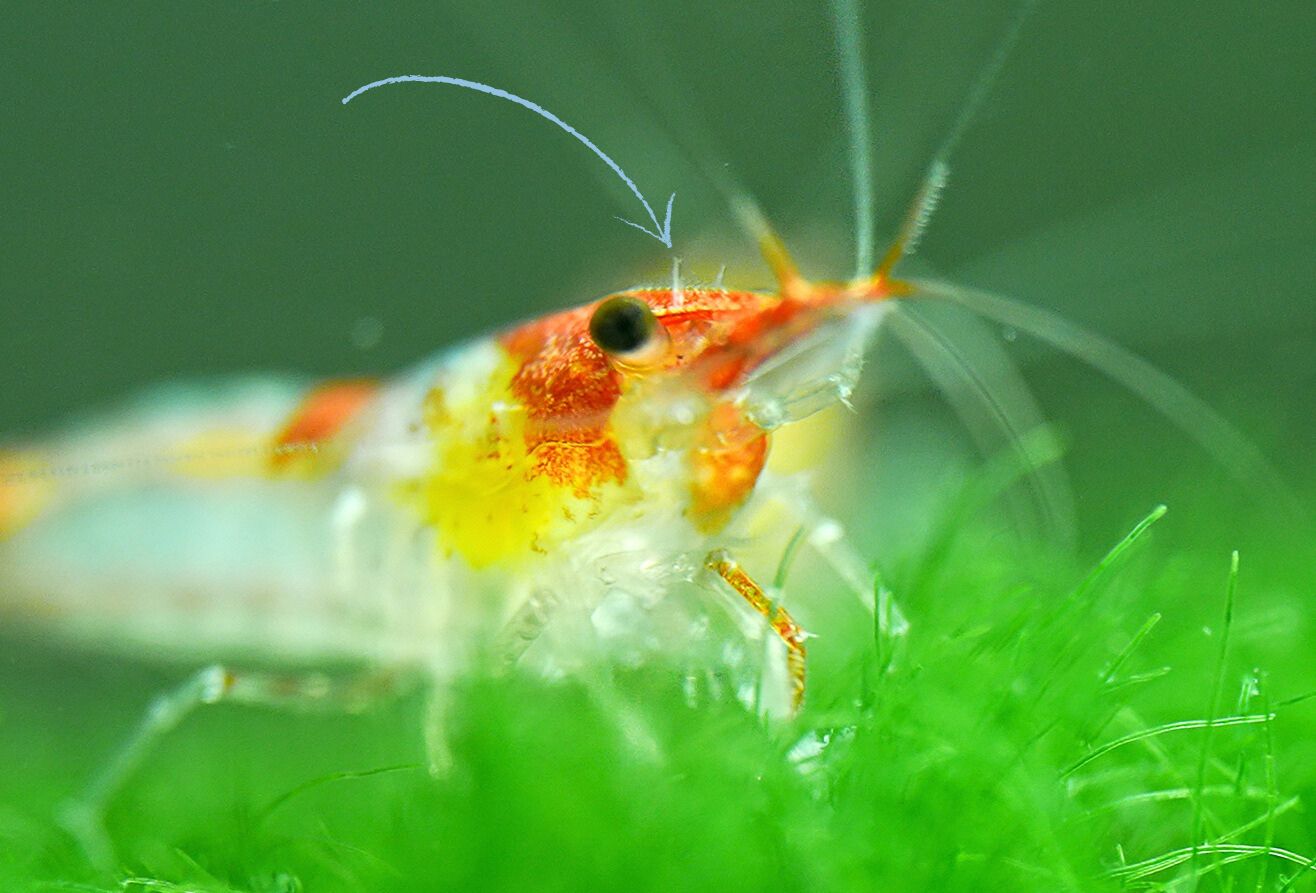
If you've just peeked at your aquarium and asked yourself this question, rest assured your aquatic pets have not evolved to invent monarchy. Rather, it, or (probably) they, are infected with "nose worms". These are tiny flatworms that sit vertically on the rostrum and can make it look like the shrimp is wearing a tiny, spiked tiara. The worms are very small, no more than 1–2 mm in length, and whitish in color.
It was long thought that all "crowned" shrimp carried Scutariella japonica worms. However, a 2016 study identified what it calls "scutariellid" worms of the genus Caridinicola on aquarium shrimp imported from Indonesia, for example. In 2023, scientists discovered yet another worm on Neocaridina, which they named Monodiscus kumaki. Given that it isn't really possible to distinguish between the two with the naked eye, and their effects on the shrimp appear identical, we'll still just call them all Scutariella or nose worms.
All types of nose worm belong to the order Temnocephalia, the turbellarian flatworms. This means they're closely related to Planaria, another genus of flatworms well-known to us shrimpers, although their lifestyle is quite different. Unlike free-living planarians, the Temnocephalidae can't survive out in the open; they always live on a larger creature (usually a crustacean).
Research on the Scutariella life cycle is limited, but it appears the worms are synchronized to their host's molting cycle. They lay eggs inside the under the carapace, inside the gill chamber. When the host molts, both the adult worms and the eggs will fall off with its exuvia (shed). The adults likely die, but the eggs will quickly hatch into larvae that can swim or crawl. These larvae make smart use of the fact that crustaceans will almost always come back to eat their exuvia—it contains important nutrients—to hop aboard the same host or whoever else happens to pass by.
Parasite or not?
Unlike some similar flatworms, shrimp nose worms are not technically considered to be parasites—at least not by scientists. Instead, they are epibionts: an organism that lives on the surface of another living organism without directly negatively affecting it. Unlike parasites, epibionts don't steal food from their host or feed on its tissues. In fact, the nose worms actually eat biofilm and other epibionts. But they can still have indirect negative effects, like by irritating or even blocking the shrimp's gills if allowed to overgrow.
Still, its epibiont status means there's no need to panic if you find Scutariella on your shrimp. It's not a victim, but a host, and it will not be keeling over any time soon (at least not due to the presence of the worms). The worms are hard to get rid of, but gentle treatment and simply providing good shrimp care should allow your colony to live out their full lifespans.
Symptoms of Scutariella in shrimp
Unless they're newly attached juveniles, Scutariella and Monodiscus worms are easy to spot on a shrimp if you look closely (a magnifying glass or your phone's zoom function will come in handy here). You can clearly see the light-colored "spikes" on or around the rostrum. The worms can take up much of the shrimp's face, and you may even spot them wiggling about in place.
As we've discussed, nose worms lay eggs in their host's gill chambers, allowing them to repeat their life cycle when the shrimp molts. The presence of small white dots behind the shrimp's head (just above its legs) is a sure sign your diagnosis of Scutariella is correct.
Tip: Scutariella isn't the only worm that can make a shrimp head its home (ugh!). Another species, Holtodrilus truncatus, has been found inhabiting both the pleopods and the rostrum. You can tell them apart by their shape: Scutariella is an unsegmented flatworm with a U-shaped sucker on both ends, while H. truncatus is skinnier, segmented, and lacks the tail sucker. Not that it matters — effects and treatment are the same.
How do shrimp get Scutariella?
These flatworms are most often found in imported Neocaridina (cherry) shrimp, often from Asia. This has nothing to do with inferior shrimp care in countries like Taiwan, China, and Japan. They know what they're doing! Instead, it's mostly down to scale: Neos, and increasingly bee shrimp and tiger shrimp, are bred in large outdoor ponds in order to meet demand and offer the shrimp at bargain prices.
Pond-bred shrimp are fine, but the rates of Scutariella and other epibionts or parasites are higher simply because they're more exposed. The ponds may also be overcrowded to further maximize yields, which helps the worms—and various other bugs—take hold and even take over.
Preventing Scutariella
If your shrimp are Scutariella-free when you buy them, the chances of these flatworms popping up at a later stage are slim. The only thing you really need to pay attention to here is preventing shrimp with Scutariella from entering your aquarium in the first place (although as we've seen, it's not a disaster if you do get an "infected" batch).
The reality? Unless you buy from a fellow hobbyist, almost all dwarf shrimp for sale in aquarium stores and online are imported nowadays. If you're worried about Scutariella, your best bet is to ask about a company's quarantine and treatment practicesl
Wherever you buy, don't skip the 30-day quarantine (even if the seller also quarantined the colony). Spotting and treating any illness or parasite is much easier in a small, bare quarantine container than a display tank. Worms that may have been too tiny to spot when you bought your shrimp should become visible within a month. If any appear, you can follow the instructions below.
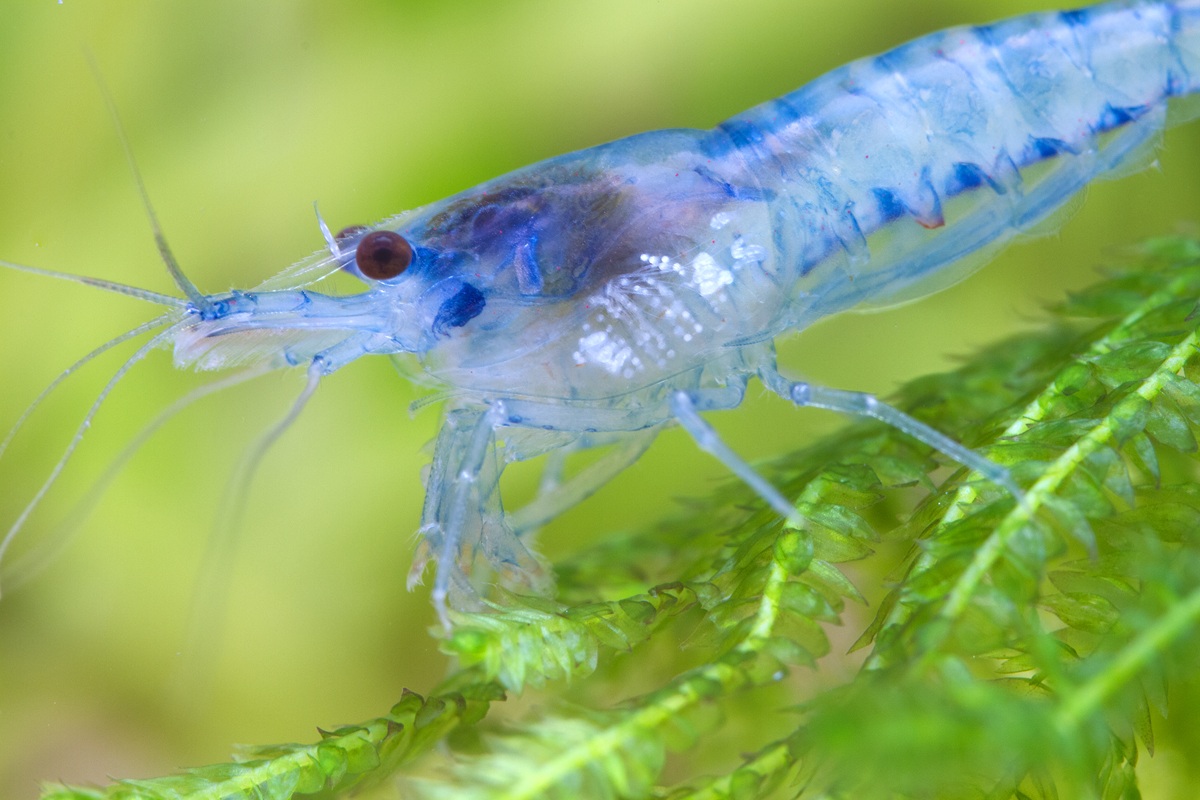
Photo by Chris Lukhaup
Treatment for Scutariella
If you find Scutariella or Monodiscus worms on your shrimp, your first question shouldn't be: what medication should I buy? Instead, it's a good idea to ask yourself whether medication is necessary at all. We've already seen that nose worms are epibionts, not parasites. In recent years, shrimpers have increasingly come around to the idea that the worms could actually be performing useful cleaning of the shrimp in order to get their daily meals. In fact, a 2012 study in crayfish found that the hosts actually grew quicker with a moderate load of similar worms attached to them!
Most of us still want to get rid of them (gross!), but we're starting to believe the casualties normally associated with these worms are probably mostly down to secondary conditions like low water quality. That's why holistic treatment is becoming more popular than the traditional nuclear tactics, like antiparasitic medication. In order to treat Scutariella naturally, we first need to understand three things about these worms.
→ In clean water, healthy shrimp will rarely become overgrown with Scutariella. They can have a few worms, but since their numbers are limited by a lack of detritus to feed on, these simply do their job of helping to keep the shrimp clean without harming it.
→ In dirty water, caused by a lack of maintenance or overcrowding of the tank, Scutariella worms have food to spare. They stop self-regulating their numbers, causing the population to explode (>10 worms per shrimp). This is when they begin to harm the shrimp, like by clogging its gills, interfering with its movements, and even causing cracks in its exoskeleton. The shrimp are also affected by low water quality, making them even more vulnerable.
→ The Scutariella life cycle involves using the host's molted exoskeleton as a hatchery and springboard, allowing them to repopulate the same or a different shrimp when it comes for the nutrients in the exuvia.
Treatment plan
If you keep these three factors in mind, your holistic shrimp treatment plan almost writes itself. No Praziquantel, no Fenbendazole, just clean water and a touch of salt:
- Whether your shrimp brought the Scutariella from Asia or became overgrown in your own aquarium, keep the water quality high. No more skipping water changes and water tests; pay attention to parameters beyond ammonia, nitrite, and nitrate.
- Whenever a shrimp molts, remove its exuvia immediately. If you do this consistently, the worms won't be able to complete their life cycle and their numbers will dwindle.
- You can technically leave the shrimp themselves alone unless they are badly infested. Still, most shrimpers like to remove adult worms and disturb the worm life cycle with salt dips; if you can catch your shrimp (which is difficult in display tanks or if your colony is large), you can give it a try.
- Optional: support overall shrimp health using antimicrobial botanicals like alder cones and Indian almond leaves.
This treatment plan isn't meant to be instant, but the worm numbers should go down. Eventually, you'll likely stop finding them on your shrimp at all.
Tip: Shrimp rely on the nutrients from their exuvia for their next molt. If you're removing their exoskeletons for worm control, offer a calcium supplement.
Sources & further reading
Brown, B. L., Creed, R. P., Skelton, J., Rollins, M. A., & Farrell, K. J. (2012). The fine line between mutualism and parasitism: complex effects in a cleaning symbiosis demonstrated by multiple field experiments. Oecologia, 170(1), 199-207.
Maciaszek, R., Świderek, W., Prati, S., Huang, C. Y., Karaban, K., Kaliszewicz, A., & Jabłońska, A. (2023). Epibiont Cohabitation in Freshwater Shrimp Neocaridina davidi with the Description of Two Species New to Science, Cladogonium kumaki sp. nov. and Monodiscus kumaki sp. nov., and Redescription of Scutariella japonica and Holtodrilus truncatus. Animals, 13(10), 1616.
Patoka, J., Bláha, M., Devetter, M., Rylková, K., Čadková, Z., & Kalous, L. (2016). Aquarium hitchhikers: attached commensals imported with freshwater shrimps via the pet trade. Biological Invasions, 18(2), 457-461.