


 Shrimp
 Fish
Fish Crab &
 Plants
 Foods
Foods Snails
Vorticella (White "Fungus") on Shrimp: Identification, Treatment & Prevention
Is that shrimp... moldy? If you've just peeked at your shrimp tank and asked yourself this question, your invertebrate friends likely have Vorticella. Sounds ominous, but it's not as bad as you might think. Let's find out what Vorticella is, whether your shrimp will need treatment, and how to keep these microorganisms out of your aquarium in the first place.
Table of Contents
What is Vorticella?
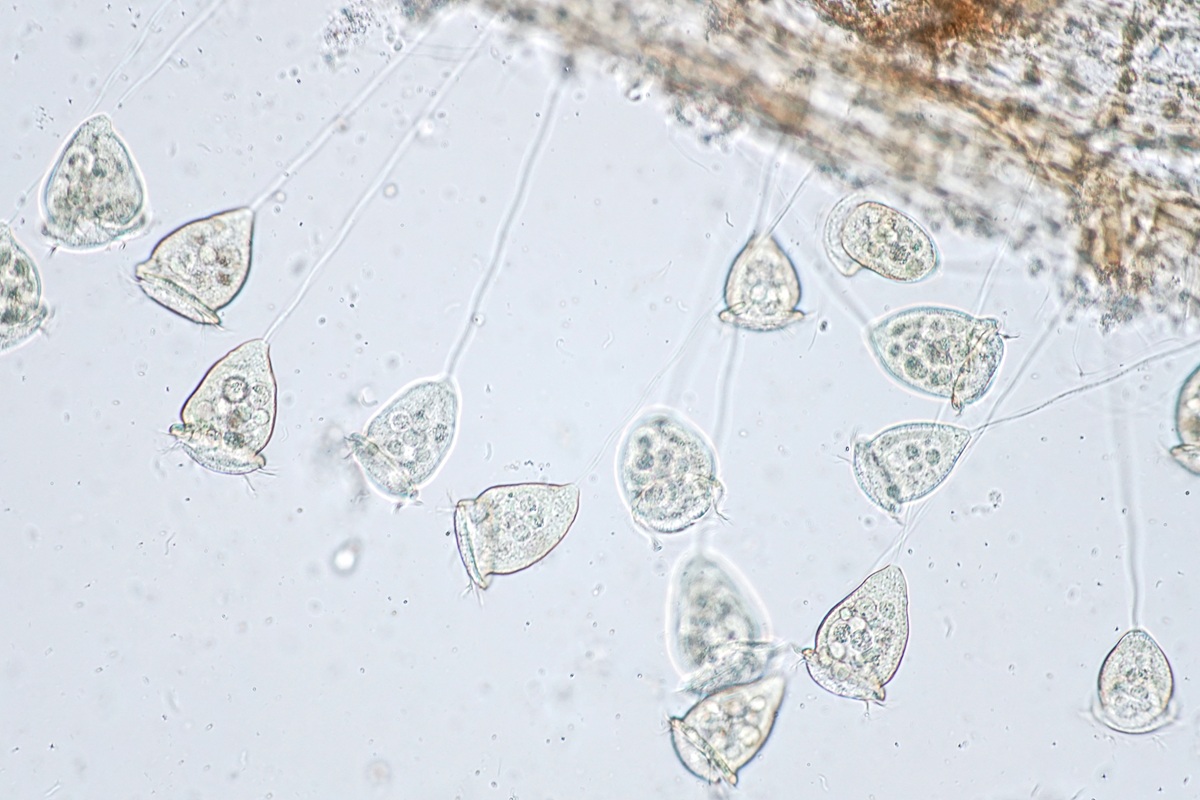
It may look like a layer of hairy mold around your shrimp's head, but Vorticella is actually a ciliate. In English, that means it's a single-celled organism with small, hair-like protrusions. It grows in small bunches, with a long stalk and bell-shaped body—think a bouquet of tulips. Although Vorticella starts out its life as a free-swimming organism, known as a telotroch, it only moves as far as it needs to find a good spot to settle down for the rest of its life.
Vorticella mainly occurs in freshwater, where it feeds on bacteria using its cilia. Because it can't move around, it has to make sure food comes to it rather than the other way round. Settling in a high-flow location can help, but Vorticella doesn't depend on coincidence alone. Instead, it beats its cilia into a tiny vortex that draws in prey—that's where its scientific name came from.
Free-swimming Vorticella telotrochs will settle on almost any surface they come across, including mud, plants, and leaf litter. If they bump into a living creature like a shrimp, they're happy to hitch a semi-permanent ride on that as well, particularly in the flow-rich gill area. It's no problem if the host molts or even dies: Vorticella will simply revert to the free-swimming telotroch stage, swimming around until it finds a new surface, starting the cycle all over again. This could be another shrimp, or even the old one if it molted rather than died.
Did you know? Technically, many of the "tulip bouquets" we find on our shrimp aren't Vorticella, but belong to other ciliate genera like Epistylis, Zoothamnium, and Carchesium. It's very difficult to tell the difference between these microorganisms even when viewing them under a microscope, so we'll just keep referring to them by the name you most likely know them by: Vorticella.
Parasite or not?
Because Vorticella doesn't feed on its host's tissues or steal food from it, it's considered an epibiont (an animal that lives on another animal without negatively affecting it directly) rather than a parasite (an animal that lives on or in another animal, causing direct negative effects to its host). This doesn't mean epibionts can't cause damage. It just indicates that any negative effects, like making it harder for the host to move or even blocking its gills, are indirect and unintentional.
In the wild, these ciliates generally hang out on their shrimp hosts without ever causing problems. The limited amount of bacterial meals available in a healthy body of water means they're unlikely to overgrow. Aquaculture facilities can be a completely different story. A 2018 study of Vorticella on Neocaridina (cherry) shrimp in aquarium stores in Taiwan explains:
"These invasions rarely cause death in the wild, but under the stressful conditions often found in densely stocked aquaculture ponds and tanks, they can get out of control and have a negative impact on mobility, molting, growth and function. Breeding and feeding may stop, and this may result in death."
Overcrowded ponds and tanks stuffed with shrimp are Vorticella heaven thanks to their high bacterial load. The increased food availability means there's room for infinite stalks, but when they grow unimpeded, their sheer numbers can become harmful to the shrimp.
Where does Vorticella come from?
We know what you're thinking—your shrimp tank can't be compared to an overcrowded breeding pond, thank you very much. You're right, and that's why our Neos and bee shrimp don't usually develop Vorticella overgrowth in our indoor aquariums. Clean water puts a limit on bacterial growth and how many microorganisms can survive on a single shrimp in the long run.
Most cases of Vorticella in ornamental dwarf shrimp are picked up at the source. As we explain in our guide to another common shrimp epibiont, a worm known as Scutariella japonica, the shrimp hobby has exploded in popularity in the past fifteen years or so. The result is that breeders and sellers can often barely keep up with demand. The shrimp are commonly imported from Asia, where they're bred in large outdoor ponds in order to keep up the supply without raising prices.
This doesn't make Asian breeders bad, nor the sellers who import shrimp from them. But it does mean that whenever you buy shrimp that you're not sure have been bred in closed aquariums (like when you buy from fellow hobbyists in the USA), it's a good idea to ask about the seller's quarantine and treatment policy. A quarantine period of thirty days at the store ensures Vorticella shows up and can be treated before the shrimp are shipped. As we've seen, there's no need to panic if you find these epibionts on your shrimp—but it's still preferable not to bring them into your tanks at all.
Once you receive your shrimp, quarantine them for another thirty days at home. Any infestations that may have escaped the seller's attention will hopefully become visible during this time, and treating shrimp in a quarantine tank is infinitely easier than trying to do so in a display aquarium!
Symptoms of Vorticella on shrimp
If you've never seen a shrimp affected by Vorticella before, it can be difficult to distinguish from a fungus thanks to the "hairy" appearance of the tiny stalks. Because the ciliates mostly grow on the shrimp's head, they can look a little like Scutariella flatworms. The worms are generally thicker and fewer, however, looking almost like a crown on the shrimp's head. True Vorticella is fine, white, abundant, and can range from white or transparent to green or yellowish.
If the ciliate load on a shrimp is high, especially when the Vorticella spreads to the pleopods, it can start acting "off". The easiest behavioral symptom to spot is an inability to swim properly. If your shrimp are suddenly swimming in circles or even upside-down, it's a good idea to whip out a magnifying glass (or your phone's zoom function).
Shrimp with very severe Vorticella infestations may stop eating. In extreme cases, you'll find them on their sides, unable to take up enough oxygen due to their gills being covered in ciliates.
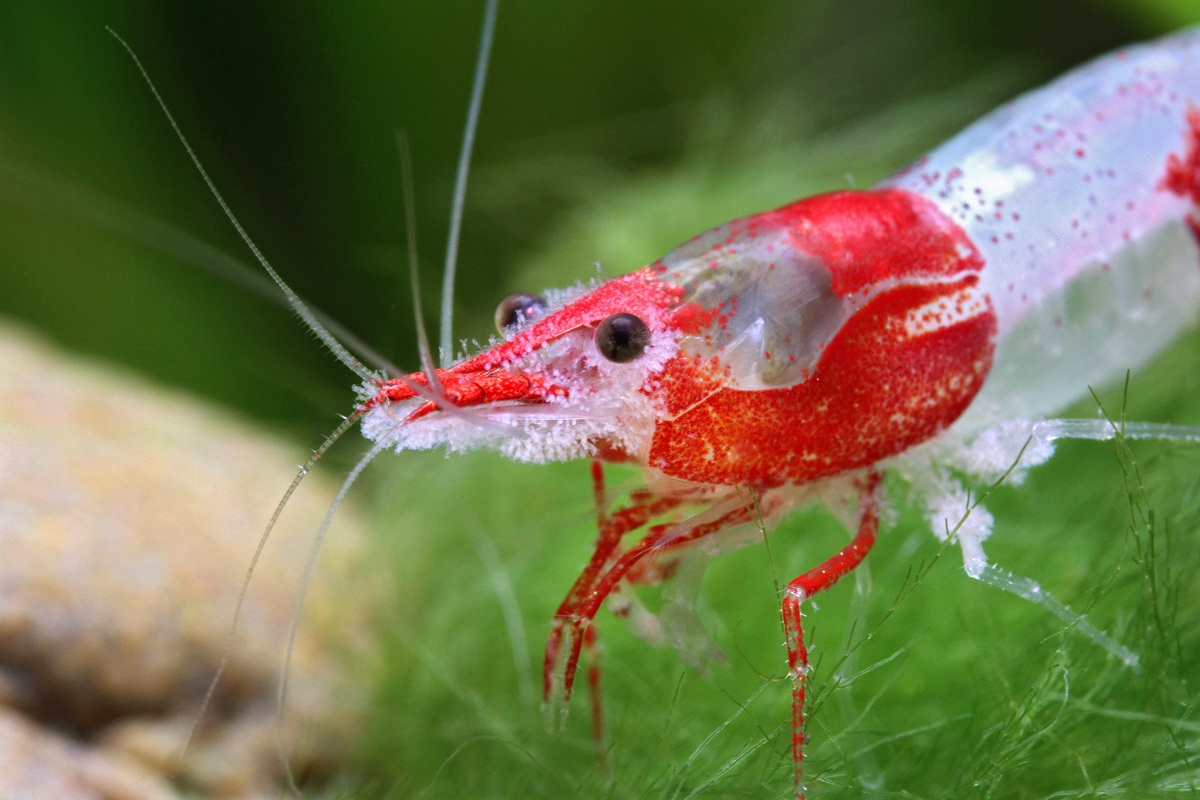
Photo by Chris Lukhaup
Treatment for Vorticella
If enough Vorticella stalks have covered your shrimp for them to become visible to the naked eye, it may be a good idea to start treatment. That doesn't have to mean medication; your first step should always be a full water test panel. Have you been keeping up with tank maintenance? Is it possible waste has accumulated, the water quality has dropped, or the aquarium is overstocked? Clean water is your #1 ally in the battle against Vorticella.
If you only just got your shrimp, the conditions in your tank obviously aren't the source of the problem. Still, you'd do well to keep the water in tip-top condition to avoid causing the affected shrimp more stress. You can also add a few Indian almond leaves for immune support.
Some shrimpers isolate fuzzy shrimp to prevent them becoming sources of Vorticella telotrochs with every molt, and to allow individual salt dips, but keep in mind the whole tank will usually already be affected by the time you spot the "hair". If you don't think isolation will help, do still remove molts and dead shrimp immediately.
Aquarium salt
There are many substances out there that will kill Vorticella: potassium permanganate, formalin, malachite green, copper sulfate, and more. These can all be found in common aquarium medications, but we don't recommend them as a first line of treatment. Copper in particular is deadly to shrimp in small concentrations, and the other chemicals can be very harsh on the gills. Not ideal for shrimp whose respiratory system is already affected by Vorticella!
Instead, the first line of defense is aquarium (not table!) salt. There are two ways to use salt against Vorticella:
- Isolate shrimp for individual salt dips (1 tbsp per cup of water, shrimp added for up to 1 minute). This works best if the shrimp are in quarantine, because catching them is a nightmare otherwise; and anyway, they may get covered in ciliates again when they return to the display tank.
- Lightly salt the entire tank (1 tablespoon per gallon of water, or 2 tbsps for hardy cherry shrimp). Raise the salt concentration over the course of 2–3 days and maintain it for up to two weeks to kill Vorticella through osmotic disregulation.
West Indian bay tree oil
Many shrimp breeders swear by a product called Pimafix against Vorticella. It contains West Indian bay tree (Pimenta racemosa, hence the name) oil, and although no official experiments exist, it's commonly reported to work well. It's safe for shrimp at the recommended dosage and can be combined with salt treatment.
Some shrimpers include a different product called Melafix in their medication "stack". Anecdotes indicate it doesn't do much against Vorticella on its own, but the tea tree oil it contains may help keep bacterial numbers in check.
Hydrogen peroxide
We're bleaching the shrimp! Just kidding, but shrimpers have noticed that H₂O₂ kills ciliates like Vorticella and is well-tolerated by shrimp. You can use 1ml of 3% hydrogen peroxide per gallon of aquarium water before turning off the tank lights for the night (light oxidizes it quickly). Repeat after 48hr if necessary; no need to remove salt or Pimafix if you were using those. The hydrogen peroxide disappears by itself.
If you don't see results, you can consider upping the dosage to 1.5ml hydrogen peroxide per gallon.
Treatment plan
Every shrimper has their own opinions and preferences, but here's a 3-week treatment plan you can follow:
- Raise the salt concentration and catch individual shrimp for salt dips if possible.
- If after 7 days there is no improvement, add Pimafix treatment (recommended dosage, 7 days).
- If there is still no improvement after the mixed treatment, add a dose of hydrogen peroxide every 48 hours for another week or so.
With some luck, you won't even have to take it beyond Step 1. Don't forget the regular weekly water changes—adjust the salt and Pimafix concentrations accordingly.
Last resort
It's uncommon, but if your shrimp are still struggling after salt dips, prolonged raised salt concentration, and Pimafix, you can consider looking into the chemicals we mentioned earlier. None of these have been extensively tested on ornamental shrimp; we could only find obscure (often old and foreign) references, mostly from prawn aquaculture farms. All of these targeted ciliates, though not necessarily Vorticella.
Proceed at your own risk carefully and as a last resort: all these substances are not just toxic to ciliates, but also shrimp and humans.
| Chemical | Concentration | Duration | Source |
|---|---|---|---|
| Chloroquine diphosphate | 1.1 ppm | 2 days | "Prawn Diseases" |
| Formalin | 50–100 ppm | 30 min | "Prawn Diseases" |
| Formalin | 30 ppm | ? | "Prawn Diseases" |
| Formalin | 25–75 ppm | 6–8 hr | "Gill Disease in Penaeid Shrimp" |
| Cutrine-Plus (chelated Cu) | 0.15 ppm | ? | "Gill Disease in Penaeid Shrimp" |
| Quinine bisulfate | 5 ppm | ? | "Gill Disease in Penaeid Shrimp" |
| Chloramine T | 5 ppm | ? | "Gill Disease in Penaeid Shrimp" |
| Quinacrine HCl | 0.6 ppm | ? | "Gill Disease in Penaeid Shrimp" |
| Trifluralin | 0.2 ppm | 24 hr | "Microbial Diseases of Prawns" |
| Tannic acid | 50 ppm | Short dip | "Method for treating Vorticella nebulifera disease of fish" (Patent) |
Sources & further reading
Liao, C. C., Shin, J. W., Chen, L. R., Huang, L. L., & Lin, W. C. (2018). First molecular identification of Vorticella sp. from freshwater shrimps in Tainan, Taiwan. International Journal for Parasitology: Parasites and Wildlife, 7(3), 415-422.
Patoka, J., Bláha, M., Devetter, M., Rylková, K., Čadková, Z., & Kalous, L. (2016). Aquarium hitchhikers: attached commensals imported with freshwater shrimps via the pet trade. Biological Invasions, 18(2), 457-461.