


 Shrimp
 Fish
Fish Crab &
 Plants
 Foods
Foods Snails
Cotton Wool Disease/Oomycetes in Freshwater Shrimp | Fuzzy White Growth on Shrimp?!
Fungus on your shrimp? It's not common, but it can happen. Below, we'll explain how to tell whether your shrimp truly has cotton wool disease, what causes this deadly white fuzz, and whether there are any treatment options.
Table of Contents
Diagnosis: Cotton wool disease vs Vorticella vs Scutariella vs Ellobiopsidae
The bad news? Shrimp rarely recover from cotton wool disease. The good news? This ailment is actually quite rare in our aquarium specimens. Most cases of fuzzy white growth on shrimp are NOT cotton wool disease — and have much better recovery rates. So before you panic about fungus, let's make sure that's actually what it is.
You should be able to diagnose your shrimp visually. A magnifying glass or the zoom function on your phone will help:
→ Is the fuzz only on your shrimp's head? If so, it's almost certainly NOT cotton wool disease, which almost always targets the legs as well. Please head to our guide to Vorticella in ornamental shrimp instead. If there are only a few tendrils rather than general fuzz, or you see dots inside the shrimp's exoskeleton behind the head, it may have Scutariella.
→ Is the fuzz between your shrimp's legs? Please inspect the color. Cotton wool disease is white or lightly grayish. It's usually found between either the walking or swimming legs. If the fuzz is yellow or green and limited to the swimming legs only, your shrimp almost certainly has Cladogonium (sometimes incorrectly called Ellobiopsidae).
What is cotton wool disease?
Confirmed cotton wool disease? We have to be frank with you: the prognosis isn't good. Healthy shrimp almost always resist these infections just fine. This means that if the white fuzz has taken hold, the victim's immune system was likely already affected by factors like stress, low water quality, or other diseases (secondary infection). Before we move on to treatment options, let's get to know our enemy and find out exactly why it's so deadly.
Cotton wool disease is almost always classified as a fungal infection (it's also called water mold), and that definition works fine in practice. This being said, the microorganisms responsible for your shrimp's fuzzy appearance — of the genera Saprolegnia and Achlya* — aren't true fungi. Almost none of the shrimp diseases referred to as "fungus" are! Their correct name is "oomycetes", of the taxon Oomycota. They are more closely related to the annoying brown algae we hate finding in our aquariums than to real fungi.
You've actually most likely heard of oomycetes before. Late potato blight (Phytophthora infestans), one of the main culprits of the Irish potato famine and the bane of hobbyist tomato growers, is probably the best example. Unlike potato blight, however, the oomycetes that affect shrimp rarely attack healthy specimens. They're opportunists that go for weakened animals — and actually seem to prefer fish to shrimp. Worth keeping in mind if you keep a mixed aquarium.
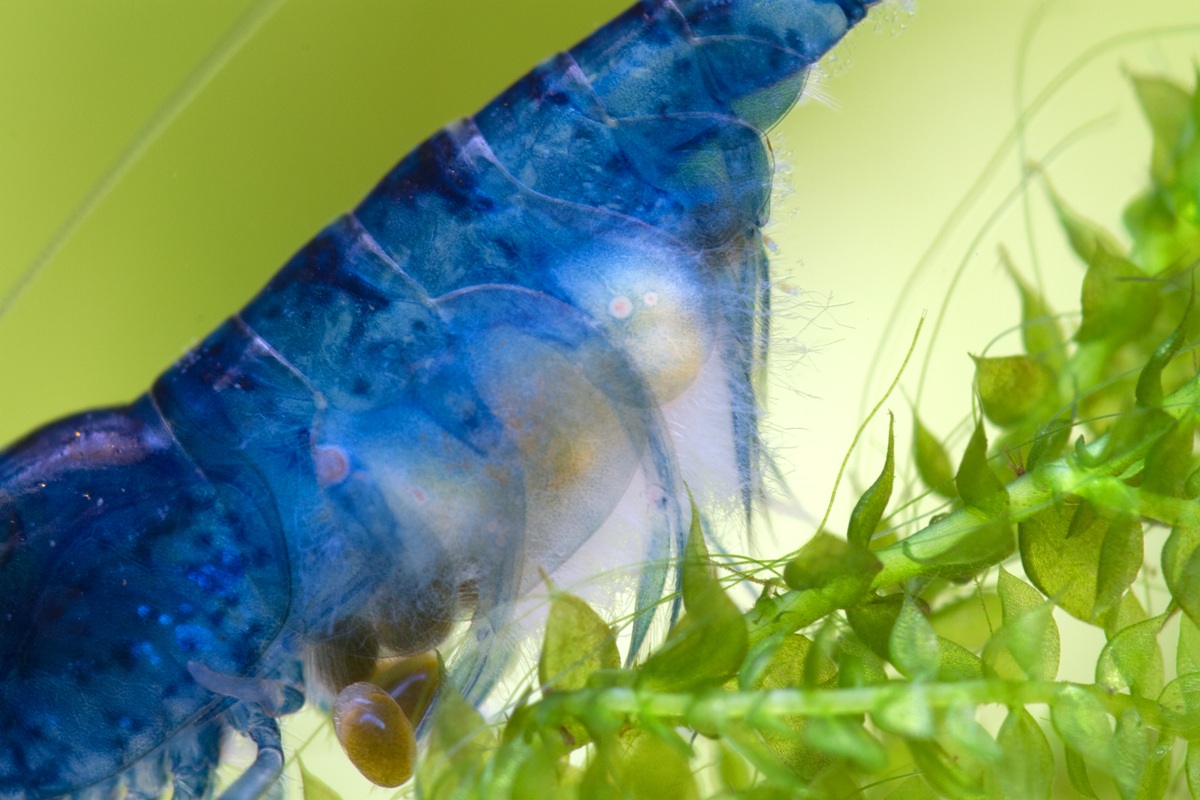
Photo by Chris Lukhaup
How does a shrimp get cotton wool disease?
Where do oomycetes like Saprolegnia and Achlya come from? How do they know your shrimp is stressed or ill and makes for easy prey? Prevention is better than cure, especially for highly deadly afflictions like cotton wool disease in shrimp, so let's take a look at what you can do to make sure oomycosis doesn't happen (again).
Your approach definitely won't involve preventing the oomycetes from popping up in your tank, because their free-swimming, unicellular "seeds" (zoospores) are present in pretty much all freshwater environments. That includes our aquariums. The zoospores possess tiny "tails" (flagella) they can use to propel themselves through the water in search of a place to settle. Thanks to their chemical attraction to damaged tissue, they know exactly where to go, homing in on their target like microscopic heat-seeking missiles.
The zoospores' ideal place to settle is the weakest part of your stressed shrimp's exoskeleton, the legs. Once the zoospores find their target, they quickly land on it and create a protective capsule around themselves. Germination follows shortly after, which involves the zoospore actually "rooting" into the shrimp's tissues, sending out tendrils that excrete digestive enzymes. In English: oomycetes dissolve your shrimp's cells and eat it from the inside out.
Once the tendrils — similar to mushroom mycelium — are firmly established, the oomycete turns to reproduction. New tendrils now begin growing outward, creating that typical cottony look we associate with fungus.
Note: We can't find any studies explicitly confirming this, but cotton wool disease appears most common in berried females. There's a reason you'll spot them fanning and caring for their eggs almost constantly: dead eggs are disease magnets and an ideal entry point for oomycetes.
Can I save my shrimp?
We mentioned something crucial about cotton wool disease above, namely that the fuzz doesn't show up until the oomycete is very firmly established. If you see it on your shrimp, that means it's almost always already critically affected (think about how you have to throw most foods out even if there's only a tiny visible amount of mold present). Combine this with the fact that your shrimp was likely already stressed or ill before the oomycete took hold, and the outlook becomes pretty bleak.
We've seen sources mention a "good success rate" if you catch oomycosis early, and that shrimp can sometimes molt off the infection. This may be true if you diagnose when the fuzz is still barely visible or limited to a batch of eggs (the female may indeed molt them off), but these early diagnoses are not very common. We don't want to give you false hope, although we'll discuss some treatment options for individual affected shrimp just in case you'd like to give them a try.
Even if you've only got one fuzzy shrimp, consider the oomycete zoospore load in your tank to be very high — and any slightly weakened shrimp at risk. Unless you only just got the colony, in which case the stress during shipping may have gotten to them, there is almost certainly something wrong with your aquarium that is stressing out your shrimp and affecting their immune systems.
→ Have you been keeping up with water changes? Could the tank be overstocked? You need a full water test panel (cycle parameters, pH, GH, TDS, everything!) and to be honest about whether you've let maintenance slip.
Aside from checking the parameters and cleaning up the tank:
- Lightly salt the tank to help keep the zoospore load down. Add 15g aquarium salt (~1 tbsp) per gallon of water. Don't forget to subtract volume for the substrate and equipment. Raise the concentration slowly, maintain for up to a week, then slowly let it fall with water changes. Keep an eye out for any signs of distress in the shrimp. This is NOT a replacement for proper tank maintenance!
- Add half a blanched Indian almond leaf per gallon of water. Studies suggest the tannins and humic acid are effective against oomycetes like Saprolegnia. API PimaFix can also offer mild support.
- Check for fuzzy shrimp daily. Remove/cull affected individuals immediately to prevent them from shedding spores all over the place.
Isolation + salt + botanicals usually suffice to stop the oomycetes from infecting more shrimp. Still seeing newly fuzzy or dead shrimp after a week? You could consider tank-wide hydrogen peroxide treatment (guide coming soon!) or a halved dose of a fish antifungal like JBL Fungol or Sera Mycopur. These both come with their own risks to the health of your shrimp and beneficial cycle bacteria, however. Prioritize cleaning + salt.
Treatment options for affected shrimp
Fishkeepers have quite a few options when it comes to treating oomycetes, but we shrimpers have to make do with very little because our crustacean friends are highly sensitive to most fish medications. Given that shrimp with visible Saprolegnia/Achlya tufts will more than likely die anyway, though, you can opt for a last-ditch treatment if you so desire. Do separate them from the rest of the colony, and prioritize fixing the overall health of your shrimp tank.
You can consider trying:
- Salt dips are reasonably well-tolerated by shrimp, but kill external oomycete spores.
- ⚠️ Hydrogen peroxide dips (again, guide coming soon!) are stressful but do kill external oomycete spores.
- ⚠️ Methylene blue dips are not very well-tolerated, but 5-10 ppm could work as a nuclear option.
Sources & further reading
Ackah, M., Ali, S. E., Sowah, W. N., Asamoah, E. K., & Addo, S. (2025). In vitro and in vivo activity of herbal and chemical treatments against Saprolegnia ferax—a causative agent for saprolegniasis. Aquaculture International, 33(1), 67.
Bagy, M. M. K., Khallil, A. M., & Obuid-Allah, A. H. (1992). Fungi inhabiting some aquatic macro-invertebrates and water plants of the Nile at Egypt. Zentralblatt für Mikrobiologie, 147(7), 459-475.
Rezinciuc, S., Sandoval-Sierra, J. V., Ruiz-León, Y., Van West, P., & Diéguez-Uribeondo, J. (2018). Specialized attachment structure of the fish pathogenic oomycete Saprolegnia parasitica. PLoS One, 13(1), e0190361.
Cover photo: Chris Lukhaup